Welcome to the Mercantile!
After 40+ years of hatmaking, I have hung up that hat and am now designing one-of-a kind garments inspired by an early 1900s aesthetic, as well as writing a retrospective of my hatmaking which I hope to publish in late 2025. Click on the tag cloud at right for my previous works, and check my Linktree for the rest of my internet footprint. I am now working on one-of-a-kind garments with an early 1900s aesthetic. Please feel free to contact me if you are interested in commission work, or scroll down to the next posts to see my current offerings.
Thank you for your past patronage, and for continuing to follow along on my ‘art-is-life’ journey.
What I’ve been up to…

Once again I have been remiss in keeping you informed of my projects over the past few months. There’s been a lot going on… mea culpa!
Walking Skirts – I have made two for personal use to try out a couple of patterns. I made the first one from a thrift store tablecloth that I found at the Assistance League Thrift Store in Wallingford. This skirt deviates from the pattern and has a bit of a tail in order to preserve the border embroidery. It also features a pleated back, with buttons at the sides for size adjustment, and a single deep pocket.


My second skirt is also made from second-use cotton yardage, acquired from ReCreative in Seattle’s Greenwood district. It has a single closure at center back and nearly perfectly matched stripes, though it sadly lacks pockets. Both of these skirts were sheer enough that I have also made 2 pair of Edwardian style bloomers (not shown here) from damask tablecloths to wear under them and which are surprisingly comfy.


The Next Art Coat – a work still in progress involves disassembling a wedding dress which I plan to incorporate into a sleeveless vest inspired by a 17th century men’s waistcoat. This is the bodice, which I have now finished beading and over-embroidering. It originally fastened in the back but I have reversed it so it now opens down the front. The sleeve cuffs will become pocket flaps. Stay tuned for the finished work later this year or early next.

Paper Arts – I paused textile work in August to make Moroccan-inspired paper lanterns for a community event called Luminata, a lantern festival that celebrates the Fall Equinox and which this year was attended by about 5,000 people at Green Lake Park in Seattle. I also ran the event and organized workshops leading up to that event for the Fremont Arts Council, which is why you haven’t heard from me for the past few months.


Going medieval – I have been producing 14th century inspired clothing for a musician friend. A linen hood with liripipe, a parti-colored wool sideless surcoat, a black wool tunic, and undertunics (not shown) in damask and Egyptian cotton which my friend dyed indigo. The garments shown here are made from piecing remnants together to make yardage. The undertunics were both made from thrift store textiles.


I am now making cording with an early period tool called a lucet, which I have seen affectionately referred to as a medieval fidget. It’s pretty addictive and keeps my hands busy while I’m watching the nightly YouTubes.
I am also breaking back into performance art by learning how to drum, and play clavicord and hurdy gurdy. While many people my age keep mentally agile by doing crosswords and jigsaw puzzles, my path is learning to sight read music and sing in Latin in addition to these new (to me) instruments. Wish me luck : )


Remembering the Shopcats…
Libraries have them. Turkish carpet shops have them. I have had them until quite recently. The supervisors, the comforters, the charmers…
Granada was a Snowshoe – a relatively new (since the 1960’s) and uncommon breed in the USA. He and his brother Toledo joined my household in August 2012, two weeks after Odin’s departure. Granada’s sapphire blue eyes stop traffic outside of my shop. He was the alpha male while Toledo was with us. Once he became the sole Shopcat, he played at being helpful, with a definite emphasis on play. Everything became his toy sooner or later. Granada left this mortal sphere around 3 AM on July 22, 2025, a few weeks short of his 14th birthday.
I am now a cat-free studio, with all of the advantages and sadness that brings…


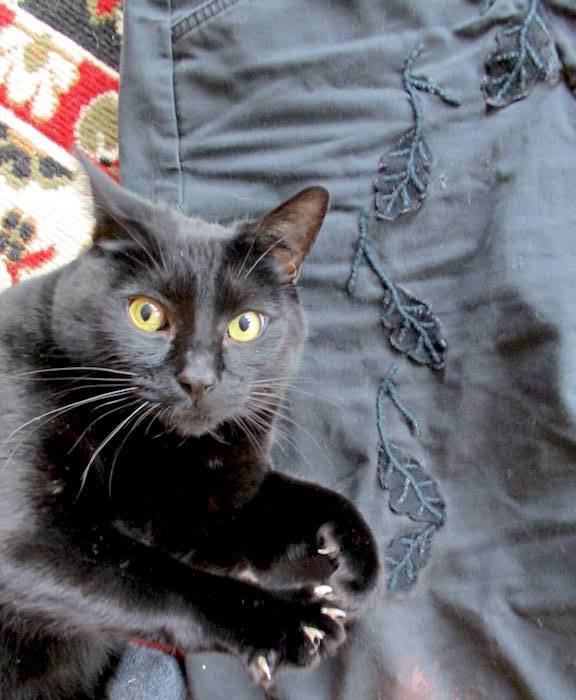
Toledo was a Bombay, jet black except for a patch of white on his throat and belly, and whiskers which started to come in white on one side of his face. He and Granada were brothers, rescued from a field in Corvallis where they were dumped when they were about a year old. Toledo was my doorbell and protector, and had a fascination for scissors and rotary cutters. He was diagnosed with early stage renal failure in 2018, and took a downward turn in January 2022. After a series of valiant rallies, he breathed his last breath at 6:35 PM on March 4, 2022 with me and Granada at his side. The shop won’t be the same without his rampant curiosity.

Odin was my original ShopCat, a domestic longhair descended from the Norwegian Forest Cat. He was also rescued after his family moved and left him behind. An operation on his right ear severed the nerves and left it partially flopped, which earned him the nickname of “Pirate Kitty” in my old neighborhood. For six months after that operation, he could not close his right eye, hence the name of Odin. He was my defender and companion through some pretty tough times. He crossed the Rainbow Bridge in August 2012, age 12.


This last photo is everyone’s favorite – the night I opened my first Mac laptop. Odin was pretty entranced with the new tech. The photo also showed that our eye color matched…

The Mercantile Hat Template Kit…
I wrapped up my first hatmaking classes at the Powerhouse, with a dozen students ‘graduating’ with a new hat and new skills. As a result of that class, and a class from last year on embroidery technique, I am pleased to continue to share my hatmaking skills by offering my first ever DIY Hat Template Kit!
These kits contain:
- Templates for a hat in both adult and child size, including a clear template for matching plaids
- An instruction manual including color photos of my favorite embroidery stitches
- 3 pages of embroidery motifs and leaf patterns
- Pre-cut linen interfacing for your embroidery
- Tissue paper for tracing embroidery motifs
This template kit will offer instructions on two styles of hat – my very popular “Classic” style with exposed seams (shown at left), and my round top hat with interior seams (shown at right, with a padded cuff). For my Classic style hat, I recommend felts (65-70% wool content), boiled wools, and coat weight wools that you put through a hot washer/dryer to shrink them and make them impervious to fray. Suggested fabrics for round top hats include jacquards, brocades, wools, heavy linens.


Pricing includes the kit + shipping and tax. If you are local to Seattle and wish to arrange for pick-up, I can deduct the $10 shipping fee.
- For WA State residents – DIY Hat Template Kit for $49
- For OR State residents – DIY Hat Template Kit for $45 (no WA State Sales Tax)
- For Canadian residents – DIY Hat Template Kit for $66 (no WA State Sales Tax).
I will invoice you via PayPal and accept payment via PayPal or personal check. If you are picking up your kit in person, I can also accept cash. Please contact me with your mailing address, email address.
Thank you for your interest in this new product at The Mercantile!

The Making of the Peacock Vest…

When I visited Chicago in 2018, one of the architectural elements that inspired me the most was the Peacock Doors at an elegant hotel called The Palmer House.
The Palmer House was built in 1871 but destroyed in the Chicago Fire two weeks after it opened; it was rebuilt in 1873 and then again in 1926. C.D. Peacock Jeweler – the first business to incorporate in Chicago in 1834 – would set up shop in the Palmer House in 1927. Its doors were designed by Louis Tiffany, who produced three sets in cast bronze, weighing in at half a ton each and valued at over $1M. At the time of my visit, the store was still there under the Kay’s Jewelers brand.


When I returned home, I tried to squeeze the design onto one of my hats, but it wasn’t a large enough canvas to do the design justice. So when I stopped making hats in 2023 and began work on a clothing line, it proved to be the vehicle I needed to bring this design to life.
I chose a Model T Duster pattern as the base garment. Fitting the pattern pieces to my dress form allowed me to determine that although I had thought to add additional gores in front and back in order to make a fuller skirt, it really only needed one additional gore at the center back. I also decided to make this garment as a sleeveless tunic-length vest.

My stash of recycled textiles yielded a lovely blue herringbone wool for the body, and a rust colored suede cloth for the peacock which would replicate the bronze color of the Tiffany doors. I made several photocopies of the photos I had taken of the Tiffany doors, and played with them on my drawing board before transferring them to the dress form, where I ultimately revised their posture so they would be asymmetrical.


Since the design was complex and I didn’t plan to line the garment, I worked the peacocks on navy tulle so I could applique them to the vest as single pieces with minimal embroidery on the body of the garment. I traced the design from the photocopy onto tissue paper, which acted as a stabilizer to the tulle. The photos below show me using a window as a light-box for this tracing. I braided yarn to lay as the tail feather spines and connector pieces, which acted as guides for positioning the suede cloth ‘feathers’.


I soon discovered that I would need to do a lot more embroidery than I had planned. I added metal studs to the tail feathers after abandoning the colored and bezeled jewels I had collected for this project. I also ended up working the body and tail as separate pieces, which ended up giving me greater leeway in placing these peacocks on the vest. For the body (and with the help of a certain ShopCat), I painted a piece of tatted lace from a wedding gown that a friend had donated. The body would prove to be more fragile and time consuming and than the entire tail.


Having run out of paint, I decided to dye the rest of the lace for the gores. But my test pieces in rust colored dye, came out maroon! A navy dye worked better; it was a good color match to the wool, and the gores would be more subtle and less of a distraction from the overall design. Another modification occurred when I tried to shape the front closure, and found the wool shaped itself naturally around the curve of the peacock’s head and neck. That was a very happy accident. (Not shown here is the hook closure behind the peacock’s head.)


In spite of my best efforts to avoid lining this garment, I ended up doing so in the areas where the applique had required the most intensive anchoring. I had just enough of a coat-weight satin to line the vest from neck to waist, and the front panels. I finished the seams around the lace gores with a rust and silver ribbon, and added a single pocket to the right side so it lays under the overflap.


After approximately 300 hours of work over the span of 2 years, I am happy with the results. The front hangs smooth and straight, while the back flows over my bustle.


This garment has been crowd tested and works equally well on all genders, as modeled below by three of my colleagues (from left to right): Kasey Cruz, Nigel Quinn and Alinne Oliviera.


I am now thinking about repeating this peacock on a shorter jacket, but in black leather on grey herringbone (a Goth Peacock!). If you are interested in purchasing this piece or the next one, please feel free to contact me. (Blouse and bustle are for modeling purposes only and are not included).
Costume Studies from Carcassonne
As many of you may remember, I toured several museums in France last year. This is the last – the Beau Arts Museum in the Bastide Saint Louis District of Carcassone.
Carcassonne is a city in two parts divided by the Aude River – the Medieval City and the Bastide Saint Louis, named after King Louis IX, who authorized its construction. The Bastide Saint Louis was built in 1260 but razed in 1355 by Edward, known as the Black Prince. It was rebuilt and fortified with a surrounding wall in 1359.
The Bastide Saint-Louis became the first cloth producer in the region in 1660, and the textile industry dominated the town between the 17th-18th centuries, peaking in 1810 when it became the center of cloth production in the Languedoc. By the 17th century, the moats were filled in and made into promenades and the fortified walls were opened. The drawbridge was converted in 1778 to the Portal des Jacobins, leading to the commercial and shopping district.
I didn’t find any traces of the city’s textile industry legacy in this district, not even a token fabric store:)
The Beau Arts Museum is housed in a building dating to the 16th century and houses modern works and religious artifacts in one wing, and a collection of some very large oil paintings in the other. For a general recap of the museum, please visit Bastide St. Louis – The Director’s Cut at Daveno Travels. This page will focus on the fashion studies I photographed in the “room of gigantic oil paintings.”
This one, painted by Jean-Paul Laurens in 1879, depicts the Albigensian Crusade. It depicts Bernard Delicieux (1260-1320), the Franciscan who resisted the Inquisition in Carcassonne and the imprisonment of the Cathars.

The noblewoman kneeling in the foreground was especially well detailed.


This one was painted by Dirck Hirs (1591-1656), a Dutch Golden Age painter known for his festivals and ballroom scenes. I was especially taken by his shoes and the slash/puff treatment at his knee.

I did not capture the title of this painting nor its artist. But I did capture some of its detail…


…as well as another of the same genre…


“A Portrait de Femme” by Emile Roumens (1825-1901) depicted a delightful little scene of a would-be suitor apparently being rebuffed by a young woman who apparently had more interesting things to do. Again, the detailing of the clothing and her work kept my attention on this painting for several minutes.


I appreciated this pair – his for his cravat and loose lapels on his waistcoat, and for the lady in her Turkish inspired dress and hat.


And lastly, this lady for the use of lace in her gown

If anyone can identify the titles, dates and artists not already noted here, please drop me a line and I will add that information to this post.
Recent Wearables…
After returning from a Gala and then regurgitating that atmosphere to celebrate World Art Day at the FAC Powerhouse, I have now returned to personal projects.
I received a ‘hand-me-down’ bag of iron on patches that were a pretty close match in size to campaign button-backs that I found at the Powerhouse. They posed a dilemma since the surface was covered with heavy beads and chain, so I used an embossing gun to activate the adhesive on the backs of the patches to glue them to the metal buttons. A friend designed and 3-D printed a jig that allowed me to drill through the buttons without caving them in (thanks Seth!).


Once the pieces were drilled, I used a dress form to lay out my design. I had originally planned to intersperse the embroidered medallions with plain ones, but changed my mind when I downsized the piece to a more street-wearable configuration. The pieces are wired together and backed with fake fur to bury the ends of the connecting wires and make the piece more comfortable to wear. I have submitted this piece to the Seattle Recycled Arts Juried Art Show at Fogue Studios & Gallery. I’ll announce on Facebook if I am accepted to that show.


I’ve also started a Peacock Coat. The coat is very loosely based on a Model T Duster pattern from Folkwear, the peacock is inspired by the Peacock Doors at the Palmer House in Chicago, which I visited in 2018 and have been wanting to commit to a textile ever since.


After seeing embroidery being done on a Chinese gauze coat somewhere on Instagram, I decided to work on net, so I can applique the finished peacock, rather than embroidering directly on the coat which would then require the coat to be lined. The tail wasn’t as challenging as I expected, though I think the body of the bird will be embroidered on a piece of the suede cloth due to the complexities of the pattern.


I’ve also started making my own undies, using a 1913 brassiere pattern from Wearing History. I made some mistakes on the first one, which I corrected on the second, including the addition of boning at the sides and front closure. The blue one is linen and lace, the green one is brocade lined in cotton sheeting, with lace trim and ribbon straps. Both are made from second-hand materials I already had in my shop. I found that crossing the straps in back keeps them from falling off-shoulder.


I will not be offering these for sale, but recommend the Wearing History pattern company should you wish to make your own. They are far more comfortable than their modern contemporaries (and infinitely cheaper) and work really well in tandem with my under-bust corset. They have also become fun day-wear around the studio.
Back from the Gala…

I’m back from “Botanical Bacchanal” – this year’s fundraising gala for the Fremont Arts Council. Shown above are two of the fashions that I created for this event.
If you’ve been following me here, you know that the work at left, entitled “Dangerous Beauty” was a Victorian inspired fashion, for which I turned brocade scraps and found flora into poisonous flowers that might have been found in a medicinal specimen garden from the period. Worn in spectacular fashion by Ms. M.

I portrayed a goddess character for the Moon Garden Room, and wore a collection of things from my closet, including a kimono I hand embroidered in gold chrysanthemums, a men’s jacket and shoes from India (both thrift store finds) and a headdress crafted from a painted paper lantern supported by a pressed metal crown I brought back from Venice. A lace crown (gifted to me decades earlier) supports a beaded veil. Chinese nail covers, a cloth of silver face mask, and a leather and brass belt completed the look.


To preserve my kimono but still wear a garden, I found a lace shawl and covered it with fabric and beaded flora, much of which I painted with diluted gold paint to dull down the ‘wedding white’ and to keep the color palette more consistent. I also embedded a strand of fairy lights into the back of the shawl, and hid the battery pack amongst the foliage on my right shoulder.


The blue tunic at upper right, was a piece I made for the auction. It was a very large cut velvet scarf with an unusual two-way design that allowed me to cut a neckhole in the center and still have the pattern directionaly correct both front and back. I lined it with a soft grey silk remnant in a woven bamboo pattern, which miraculously was the same size as the scarf. The side seams are held together with Balinese silver beads, which also weight the corners of the hem. It was the only fashion piece in the live auction, and the winning bid was $650!


I also collaborated with another artist – Feej from Black Jar Follies, who asked me to clothe his MoonChild – a luminary he created for the Moon Garden Room (designed by Norma Baum). I offered to paint black stripes onto a bedsheet, but then realized it would block too much light, so I pieced linens together to make the t-shirt, and made the nightgown from a bed ruff and inset strips and sleeves from an eyelet lace shirt. We were both pretty happy with the result.


It was my first gala, and a pretty fun evening for a great cause. Thank you Fremont Arts Council for showcasing our talents and enlisting us to help raise funds to support local arts and art events!


A Photo Shoot with Ms. M…
Ms. M arrived for her final fitting. It was such a beautiful day that we took advantage of the late winter light, and stepped outside for a photo shoot. We had a great time getting some pretty fabulous shots of her as she modeled my “Dangerous Beauty” fashion for the upcoming Botanical Bacchanal Gala for the Fremont Arts Council.
Ms. M. never stopped smiling and I couldn’t be happier with the results. Now we just need to figure out the hair and makeup to complete her look…


A Botanical Gala Gown – Part 3: The Jacket and Hat…

The jacket for this ensemble was a Very Lucky Find at the Goodwill bins in Seattle’s Sodo district, where you buy by the pound. The jacket had beaded seams and a scalloped hem at the front, a short tail at the back, was well constructed and in great condition. The label said Mariella Ferretti – it’s a jacket from a 3 piece suit that originally cost $325. I think I snagged it for about $2.
I folded the collar upward, which made the modern notched lapel disappear and extended the chest size of the jacket. I planned to fasten the stand-up collar with a large hook and eye, obscured by an even larger antique-looking button from my collection. My model is wearing a black lace top, so I added black lace to the front and collar of the jacket to tie that look together. I even found remnants in my stash that were exactly the length I needed for those two embellishments, and a pair of black lace mitts to complete the look.


The butterfly brooch was another lucky find, again at the Powerhouse. I think they were those hair bun holders, one of which I stripped of its pearls and rhinestones which I replaced with blue jewels and clear crystal hearts that I dyed with a black Sharpie.

It’s a good day when you -do not- break your glass-front curio cabinet when your dress form tips over while you’re prepping for the arrival of your model… The first fitting went well, and I was ecstatic to find that the jacket fit without the need for alterations.
I had planned to add black lace to the cuffs but ran out of remnants. Then I realized that fern fronds were one of Nature’s laces, so again I stripped silk from wire and sewed it to the cuffs. I added gold trim to the back hem of the jacket, and ran foliage up the back slit to visually tie the jacket into the bustle. A giant poinsettia, a water hemlock, and a few more butterflies completed the look.


It was sheer coincidence that I started reworking my bowler hat for this ensemble on November 25, also known as St. Catherine’s Day, patron saint of lace makers. The hat will have veiling, and miniature versions of the flowers and butterflies from the rest of the ensemble.

I made amarita muscaria from Styrofoam balls, cut in half and covered with brocade, with metal studs as the spots. Pieces of avocado bags form a bed of lichens for the flora to nestle into. The lace that trails down the back has clip-on butterflies, which carry the theme upwards from the bustle.


I lucked out in finding miniature poinsettias on a garland at the Powerhouse. I replaced the plastic centers with beaded ones, and cut leaves down to size from much larger versions. I made nightshades from a wool coat scrap, and berries from wooden beads suspended on wires. The leaves were ivy shaped until I trimmed them down to a more appropriate shape. I was of course aided by the ever helpful ShopCat.


It took me awhile to figure out the bleeding hearts. Once again, the Powerhouse yielded up exactly what I needed – little heart-shaped ornaments that I covered with lace. I also found two little cicadas done up in orange net, that I reshaped the wings and painted black to look more like beetles. I just gotta say that the Powerhouse is a candy store for scavenger artists…


I tried to give the white Water Hemlock blossoms a coffee bath but I don’t think it took. So I took a fine tip sharpie to the petals to try to give them some dimension and break up the stark white. They cascade out of a broken black beaded buckle, and were the final additions to this hat.


The full ensemble for my Dangerous Beauty is now complete. Shown here are two early progress shots and the back of the finished project. I look forward to see it modeled at our Botanical Bacchanal Gala in March!


