August Phoenix Mercantile
I used to make hats. Now I make other things…
Crossroads Tour: Last day in Istanbul…
Most of my travel journals are now at Daveno Travels where I am reissuing them as Director’s Cuts, with full text and previously unpublished photos. This is an excerpt from my first trip to Istanbul in 2011.
I’m joined at breakfast by another guest from Australia who is also leaving today. Baha offers to take us to the bazaar to buy suzani (the embroidered textiles that fill his hotel). I don’t think I can cram anything more into my suitcases but the offer is more than the Australian and I can resist.
We arrive at Baha’s favorite textile vendor and are offered tea and seats. We make our selections and are each gifted with a pillow cover. I smile when I notice that the embroidery on mine is incomplete. Baha notices, and pantomimes “needle and thread,” suggesting that I could finish the embroidery myself.

I am also gifted with a black silk ikat headscarf (shown below with a wool shawl I bought at the Topkapi Palace. Sadly, I lost both of these pieces at an event in North Seattle in 2019.)

I photograph a framed goldworked section of an Ottoman robe that is leaning against a wall behind a pile of other things in one of the booths in the Bazaar.


After that shopping expedition, I locate the Ibrahim Pasa Palace, a building that dates back to the Ottoman period which houses the Islamic Art and Ethnology Museum. It’s a treasure trove that would make some of my friends want to move here. One of the centerpieces is a nomads tent, called a kara cadir in Turkish, woven from black goat hair with center pole supports, much like a Bedouin tent.
There were Anatolian kilims here that were woven in one piece, a rare find as they are traditionally woven in two or three sections and then stitched together. Below at left is the style of carpet I was looking at in the shop on my first day in Istanbul (this one from the Caucasus, Central Anatolia-Konya, 18th – early 19th century). I am told that the more borders the carpet has, the higher the value. The $48,000 carpet I was shown on my first day here had 5 borders in addition to it being 90 years old and dyed with cochineal, indigo and saffron. (At center – a Lotto style carpet, 13-14th century, Sultan Alaadin Keybubat Mosque in Konya, with a detail shot of that carpet shown at right.)


A loom with all of the weaver’s tools laid out…

Some clothing and home furnishings, including a reproduction of the interior of an 1800’s Ottoman home. This pair of chopines for hamimi (Turkish bath) also date from the late Ottoman era. Mother of pearl inlay on wood, straps appear to be appliqued and beaded textile. Sorry I didn’t take a closer look to see if it that strap was a felt or woven piece…


After a very full and final day, I return to the hotel. My shuttle is due at 3:30 AM, and since I am the last guest, Baha and I sit and talk in the dining room. We talk about my Facebook albums, and the route my plane would take on its return to Seattle, and if there are sharks in Puget Sound. Cars, and sports, and music. Whatever small talk our tired brains could manage.
The shuttle arrives. Baha loads my book-heavy luggage into the van. He gives me a warm European-style send-off and promise to keep in touch. It has been a remarkable trip, and I will never, ever forget this place…


Read the full account at Daveno Travels.
Across Andalucia: Toledo…
Most of my travel journals are now at Daveno Travels where I am reissuing them as Director’s Cuts, with full text and previously unpublished photos. This is an excerpt from my trip to Toledo in 2012, highlighting my textile finds and hat inspirations.
My travels have taken me from Venice to Florence, and Genoa and to Istanbul – all centers of commerce during the medieval period, and of heightened artistic and scientific endeavors during the Age of Enlightenment. My next destination continues to trace a path through Europe as it existed under Muslim occupation – to Andalucia, in search of the remnants of medieval Spain when it was under Moorish rule.
Toledo is a small but historically important fortified town, halfway between Madrid and Cordoba. This Iberian city served as a Roman trade hub, a Visigoth capitol during the 6th century, and a Moorish capitol in the 8th century before the Christian Reconquista in 1085. It was the capitol of Spain until 1561 when Philip I moved Spain’s political center to Madrid. It remained Spain’s religious capitol.
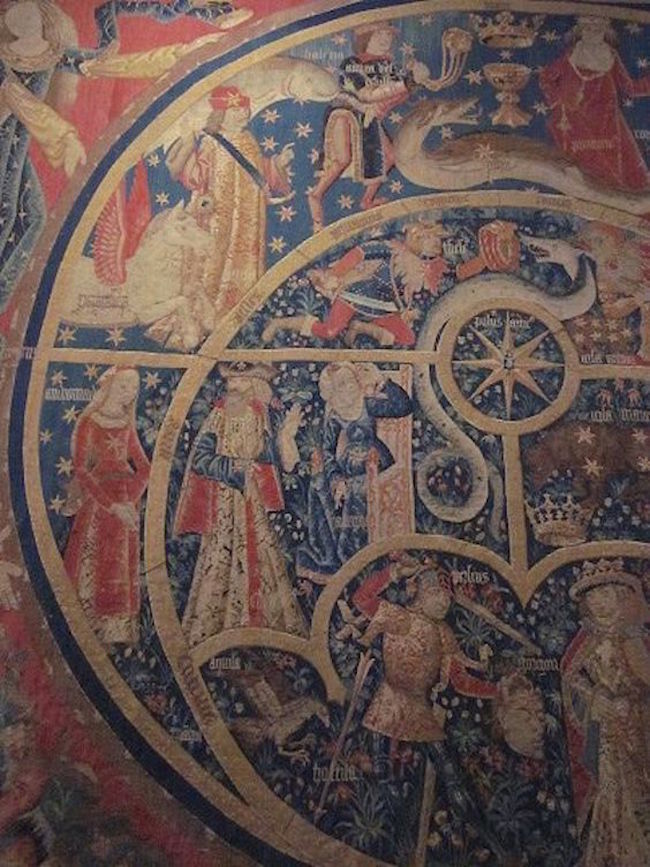
One of the highlights of this trip was the Museo de Santa Cruz, as noteworthy for its architecture as its contents, was formerly an orphanage and a hospital. It is home to the famous Tapestry of the Astrolabes. Woven in Belgium in 1480, it combines mythology and science to explain the divine world as it was perceived during the Middle Ages. It covers a wall, floor to ceiling and is about 12′ across – much larger than I thought it was. I spent about 20 minutes here, just trying to absorb all the details.


The Cathedral of Santa Isabel was built in 1227 over the foundation of a 6th century Visigoth church, which itself had been built over a mosque. It houses floor to ceiling works carved from the most beautiful marble I had yet seen. Of equal workmanship were the wooden pews, which appear to be of mahogany, and depict the defeat of Granada. The castles depicted in these carvings are stylized, but the clothing, armor and weaponry are so accurate that historians study the panels to learn the evolution of weaponry of the period. They are also said to be the largest carved choir in all of Europe.


The Chapel of St. Blaise, with its lapis-blue ceilings and murals, was stunning. The halos of the saints, done in gold leaf, were in remarkable condition for frescoes dating back to 1397. One of the treasure rooms is filled with vestments, and I see an alter cloth that had been woven by Muslims, who had included an Arabic border around the central lozenges.


The Cloister of St. John the Kings was begun in 1389 by Rodrigo Alonzo under the direction of Archbishop Don Pedro Tenorio. It was finished in 1425. Finely wrought archways surround a courtyard which is intensely lush and beautiful. This cloister would be among the finest example of Spanish-Arabesque Gothic architecture I would see on this trip. It would take me about 6 years to translate this design into one of my hats.

The rest of this journal, including photos and details about the Neo-Moorish Toledo train station and architectural detail from the mosques and cathedrals in Toledo, are now available at Daveno Travels.
Stitchery Part II: Tools and Techniques…

Through personal experience, I have found that needles of bone and ivory, although retaining a sharp point longer than other materials, are also coarser and more brittle, which causes them to break easily. Bronze needles are the best for embroidery as they have a smooth surface and are more pliable than modern steel needles. A pliable needle helps to decrease sore and fatigued fingertips.
I am fond of Chinese scissors which made from iron and hold their edge well, and which are available in a variety of sizes from the bonsai section of your garden store, or your black powder / sutlers fairs if you are a reenactor. I also keep my grandfather’s pliers close at hand because it is sometimes easier to pull -rather than push- a needle through dense fabric or leather. A Chinese pin cushion and a jade pin dish round out my kit.
Learn the rest of my favorite techniques by downloading the article:
Stitchery Part I: History and Fibers…

This 5-part series begins with a very brief historical overview and comparison of embroidery between East and West, and then delves into materials and technique. My intention with this series is to demonstrate how embroidery can be combined with other techniques to bring new color and texture to your own textile projects.
Download Part 1 of this series here:
Teaching Applique at the Seaview Fiber Arts Guild…

Back in 2015, a milliner friend of mine asked me if I might lead a workshop for the Seaview Weaving and Fiber Arts Guild, of which she was a member. Of course, I said yes. Little did they know how much trouble I would bring through their door…
I dug out my handout on the history of a few basic embroidery stitches, illustrated with both historical and modern examples, and brought examples of my own works to further illustrate the techniques and applications that were covered in the handout (which you can download at the end of this news story).
I had been asked to develop a project for 8-20 students to work on. But recreating the same project 20 times was far too boring, so I brought 20 kits, ranging from complex multi-layer reverse applique, to trapunto, to simple applique, to simple embroidery. Some kits were flowers, some were animals, others were Celtic knotworks. Each kit came with a pattern, tracing paper or fusing, instructions, and a selection of fabrics, some of which I had partially assembled if it was one of the more complex patterns.
I presented my historical overview to a receptive group of about 15 guild members, and explained how I applied historical techniques in my own work.
Then we got to work…
Everyone found a project that was interesting to them, and some members of the class even took two kits. After two hours of tracing and sewing and pressing and more sewing, a few people seemed unwilling to put their projects down in spite of a delicious lunch waiting for us in the other room…

Afterwards, I was able to see projects that the guild members were working on, including a Ravens Tail pouch with it intricate twining. I was introduced to spun nettle, which I would love to have a chance to embroidery with some day. What a tremendously creative and talented group.

For additional photos, see the Seaview Guild Blog. You are welcome to download my handout at the link below. Feel free to share : )
In the news: Green Living Journal…

One of the fun things about rebuilding a website, is combing through your archives to look for things that you need to repost, and finding things that you had forgotten you had!
Katie Cordrey wrote a piece about me for the Eco-Fashion section of Green Living Journal in Spring 2011. That article, titled Marvelous Millinery, is posted below:
Reconstructing an UlaanBaatar boot…
Several years ago, a friend and I stumbled across these boots in a military antiques shop in Seattle (now closed). We recognized them as traditional Mongolian footwear, and were informed by the shopkeeper that they are still manufactured in UlaanBaatar for the military.

When the stitching wore through the soles, I tore the boots apart to refurbish them. This article outlines the process for putting them back together again. I have boarded a few photos from that process on Pinterest.
You can download the instructions below. I highly recommend that you cut your pattern out of tag board or lightweight cardboard and tape the pieces together to make sure that they will assemble correctly, before cutting in to your leather. Also please note that the drawings in this document are not to scale …
Names from the Secret History of the Mongols…
By Heather Daveno, 1988
The Secret History of the Mongols was written for the royal Mongol family after the death of Chinghis Khan in 1227 AD. It details the history of the Mongol peoples from the birth of the first Mongol, Batachikhan, through the ascension of Ogodei Khan to the Mongolian throne. The Secret History is considered a primary source for the genealogy of the ruling families of Mongolia up to the beginning of the 14th century.
I compiled this list of names from my copy of The Secret History as adapted by Paul Khan, published by North Point Press, San Francisco, 1984. I intended it as a resource for the Offices of Heraldry for the Society of Creative Anachronism, as well as any LARP or gaming groups that may find it useful. The names are in alphabetical order, followed by gender (m/f) and page number for reference. Translation, clan affiliation and other notes from the text are included. Tribal spellings are taken directly from the text and may not be consistent throughout this catalog.
After having lost this file for several years due to a series of technology crashes, I found a copy online at the Mongolian University Library, which allowed me to reconstruct my printable list which you can download here.
Many thanks to Crystal Lin Smithwick, whose assistance in setting up the original table on my original website, was invaluable.
For additional information on medieval Mongolian naming practices, please click here.
The Mongolian invasions of medieval Europe…
“All warfare is based on deception… Feign disorder, and crush him. If he is secure at all points, be prepared for him. If he is in superior strength, evade him. If your opponent is of choleric temper, seek to irritate him. Pretend to be weak, that he may grow arrogant. If he is taking his ease, give him no rest. If his forces are united, separate them. Attack him where he is unprepared, appear where you are not expected.” — from ” The Art of War” by Sun Tzu
- My editors notes in this article are in (parenthesis). This post is an overview and supplement to my original article which is available by download a little further down this page.
Although Chinghis and Sun Tzu were not contemporaries, much of the opening quote applies to Mongolian warfare, where deception formed a basis of battle strategy, and combined with high levels of discipline, organization and personal strength to make the Mongolian army a fierce force to be reckoned with. The Mongols believed that their Great Khan was directed by God to conquer and rule the world. Resistance to him was resistance to God and punishable by death. Conquest on the scale envisioned by Chinghis¹ needed a high degree of discipline and organization. Their power lay in tribal confederation and non-assimilation of foreign ways.
The Mongolian Army – Structure
- Khan / Khagan² – Commander-in-chief.
- Noyan – The equivalent of prince, serving directly under the khan.
- Bahadur – The equivalent of knight. The Bahadur served as personal bodyguards to the khan.
- Yurtchis – Quartermaster of the ordos or camp.
- The body of the army was made of of units of Tumen, Minghan, Jagun and Arban (which are described in my original article)
The Mongolian Army – Uniforms, Armor and Weapons
White was a sacred color, reserved for the Khan, whose armor and tunic were white or white and gold. He typically rode a white mount. (I hypothesize that white did not become a mourning color in Asia until the disastrous defeat of the Mongolian forces during their failed attempt to invade Japan in 1274 and 1281.) Bahadur wore black armor, a black tunic with red facings, and rode a black horse with a red leather saddle. (The uniforms for all others, as well as the provisions they carried, are described in my article.)
The iron helmet was covered with lacquered leather (I presume to avoid rust) and had a horsetail crest. Rank was denoted by a pair of red ribbons, which hung from the crown and down the back. (It is my believe that the Manchurian hats with their upturned fur brims and ribbons down the back, evolved from Mongolian army caps.)
Mongolian archers wore a stone ring on their right thumb, which they used to release the bowstring (rather than their fingers), which increased the velocity and speed of release of the arrow. Each man carried 2 quivers, which held about 30 arrows each.
The horse was the most prized possession the Mongol owned. Steppe horses were renowned for their courage and endurance. They only needed to be watered once a day, and they could dig for grass under the snow, which eliminated the army’s need to carry feed.
Each warrior had between 3-20 horses, which allowed them to ride non-stop. A Mongolian horseman could string a bow from his saddle, as well as eat and sleep on horseback. Herds of up to 10,000 head accompanied the army and were divided by color, which served as another definition of rank.
The Mongolian Army – Training and Tactics
The harsh and demanding lifestyle provided Mongolian soldiers with endurance, mobility and other warlike qualities. Mongolians were also very dedicated to their leaders, and were highly disciplined. Their European counterparts however, went to war with little training or discipline, very little experience in fighting as a unit, and as often as not, went to war for profit under the guise of religious crusade. The feudal system allowed men to lead based on their wealth rather than on tactical ability.
Training for the hulega, or “Great Hunt”, conducted like a campaign and designed to teach discipline, strategy and unity under command.
The most often used method of attack was the tulghma, or “Standard Sweep”, with light cavalry attacking at right angles, and heavy cavalry s charging from the rear.
Another favorite maneuver was the mangudai.A light cavalry of suicide troops charged the enemy, then retreated, leading the enemy into an ambush of heavy cavalry. Units communicated with each other with a variety of signals, including whistling arrows or flags by day, torches at night.
Dispatches were sent via courier, through a pony express system called the Yam. Roads became thoroughfares throughout the Mongolian Empire, with rest stations and fresh horses every 25 miles. This allowed couriers to ride 120 miles a day. Roads also allowed the army to move columns of soldiers at great distances, making simultaneous thrusts, surrounding the enemy, and appearing to be a larger force than they actually were.
If the Mongolian army was too heavily outnumbered, they would turn aside, putting a day or two’s journey between themselves and the enemy, and then lay waste to whatever was around them, which depleted supplies that would normally have been foraged by the enemy. Mongolian armies might also retreat for 10-12 days, until the opposing army had disbanded, then attack them. Mongolians gained victory by destroying the enemy and progressively dominating the territories of those they conquered. The Mongols were able to do this in Russia by dividing the country and then weakening it.
The artillery stayed behind with the engineers (typically Persians), reserves and remounts. The Mongols learned about siege weapons from either the Chinese or the Persians, and improved upon them when they invaded Iran. Chinese siege engines used by the Mongols are described in my article
Among the Mongolian siege methods was to dam a nearby river and divert its flow to flood a city. The Amo River, used for this purpose, now has a new course from what it had prior to the 13th century.
- My thanks to the editors of The Elf Hill Times, who first published my article in January, 1998 under the title “The Mongols: Their Attempt at World Domination” which you can download here:
- This post is updated to include notes from classes I taught in 1998-99 on “Warfare in Medieval Mainland Asia”. This work has been cited in an academic research paper titled “Challenges Facing Mongolia’s Participation in Coalition Military Operations”, written by Lt. Col. Byambasuren Bayarmagnai of the Mongolian Armed Forces, published by the U.S. Army War College in March 2005.
The Mongolian Army – Invasion Timeline and Legacy
1206 – Temujin, after uniting the nomadic tribes of the steppes into the Mongolian Federation of Tribes, is proclaimed khagan, and given the name of Chinghis. He begins a series of foreign conquests the following year.
1207-1210 – Chinghis sends his eldest son Jochi to defeat the Oirat, Buriyat, Turkish Kirghiz and Tumet tribes. The next battle is against the kingdom of Si-hia in the Ordos desert. This is a stronghold of Buddhism and Chinese culture with an army of 150,000. Jochi lays siege until 1210, when the capital city of Chungsing surrenders. —In the meantime, Chinghis takes the kingdom of Karakhitai, of which most subjects are Turks. In 1209 Barchuk, the ruler of the Uighur Turks, joins with Chinghis.
1211-1217 –Jaghatai, Jochi, Ogodei and Chinghis lead three forces totaling 120,000 men across the Gobi Desert against the Chin army of 500,000, and defeat them in 1217. Turkistan is invaded on this campaign and absorbed by Chinghis in 1215.
1219 -1245 are detailed in my original article
1246-1251 –Ogodei’s widow Artedais serves as regent until the new khagan can be elected. Although Ogodei appointed his grandson Kubilai, Artedais succeeds in putting her own son Kuyuk on the throne. However, Kuyuk dies two years later and Mongke, nominated by Batu, becomes khagan in 1251.
In a controversial move, Batu later establishes himself at Sarai (65 miles north of Astrakhan on the lower Volga River) and holds his own khurlitai, where he is proclaimed (or proclaims himself) khagan. Batu breaks allegiance with Karakorum and rules independently as the Great Khan of the Golden Horde (from the Mongol altun ardu). Although Batu’s tribes are mostly Turkish, the official language remains Mongolian, and it remains a province of the Mongol Empire. This is the beginning of the splintering of Chinghis’s empire, and begins the demise of the Mongolians as a coherent ruling force by the 14th century.
Italian trade settlements at Kaffa, Sudak and Kertch are maintained by Genoese and Venetians. The Mongols take over direct administration in the Ukraine, but allow Russian princes to administer most of the rest of Russia. Tribute takes the form of annual taxes from merchants and farmers, and animals from Russian nomads and cattle breeders. The Mongols interest in land was not political (they did not care who owned it), but rather they viewed land as a source for troops and revenue, assessed through annual censuses which were carried out by the Chinese. Their only political interest was for the Russian nobility to acknowledge their khagan at Karakorum as the Supreme Ruler. Batu’s aim was to keep Russian princes disunited; rivalry was encouraged through the naming of one of the princes as Grand Duke, a title which was revoked and transferred by the ruling Khagan at will.
1255-1299 –Hulagu, a grandson to Chinghis, conquers Transoxiana, Iran and Iraq and establishes the Iklhan Horde in Iran. Batu dies at old Sarai in 1255, leaving a territory from the upper Ob River to the lower Syr Darya, and from the Caspian coast to the Black Sea. A decline in leadership begins. Berke succeeds him in 1257 and dies in 1266.
Mongke Temur becomes khagan in 1266, but Nogai Noyan is the actual hand of power, and the cause of much infighting among the Mongolian ruling class. Nogai urges the Russian princes to fight against Poland and Lithuania, while he advances on south Poland and Hungary. Mongke Temur dies in 1280 and is succeeded by Tuda Mongke, who later abdicates to Teleboge, who is later seized and given to Tokhtu whom Nogai later proclaims as Khagan.
Nogai takes dominion in the Crimea, and is later opposed by Tokhtu, who sides against him in a war between Venice and Genoa. Nogai dies in 1299. Kubilai, grandson of Chinghis, conquers China in 1279 and establishes the Yuan Dynasty. Ghazan, great grandson of Hulagu, has become a Muslim and the Ilkhans become the national dynasty of Iran. Ties to the Mongol Khagans to the East dissipate.
1312-1378 –Tokhtu dies and is succeeded by Ozbeg, who appoints Ivan Kalita of Moscow as Grand Duke. This office remains with the princes of Moscow until the end of Mongol rule in Russia. Ozbeg dies in 1341 and is succeeded by his son Janibeg who dies in 1357, and is in turn succeeded by Beribeg. The Golden Horde loses interest in lands south of the Caucasus. Beribeg is murdered in 1359. Timur becomes a major player and establishes Samarkand as hie capitol in 1335.
The Golden Horde is counter-attacked successfully in 1363 at the battle of Kulikouo by Dmitry Donskoy, Prince of Moscow. This battle is the first major defeat suffered by the Golden Horde.Civil war breaks out between rivals for the khanate and Russian princes attempting to overthrow Moscow. The Lithuanian Grand Dukes extend their power as far as Kiev. The Golden Horde’s territory is divided between the rulers of the Crimea, Astrakhan and Khwarazm. Timur Melik makes himself master of Khwarazm, and helps Tokhtamysh in his possession of Astrakhan and Sarai in 1378.
1382-1430 sees the beginning of the disentegration of the Golden Horde. The remainder of this timeline, running to 1689, is detailed in my original paper.
The Mongolian Legacy The
Mongols were the last and most destructive invaders to come from the
steppes. Even though Europe was saved from invasion by the deaths of
Ogodei and Mansu, the Mongolian campaign had the following far-reaching
and negative consequences:
- Herring glut – In 1238, the British herring
market became glutted when ships from the Baltic didn’t arrive because
of preparations they were making against the Mongols. Fifty herrings
sold for one shilling.
- Genoese monopoly – Subetai
signed a treaty with the Genoese, who acted as spies in return for the
Mongol destruction of all other trading posts in the Crimea, which gave
the Genoese a monopoly there.
- Russian economy – Russia suffered a ruined economy and exploited peasantry, as well as self-important and abusive aristocrats.
However, not all consequences were dire:
- Western Europe gained knowledge of Asia and trade routes to China were reopened.
- China flourished during Kubilai’s reign, since many of the governing officials left court and turned to artistic and scientific pursuits.
- The Eastern Orthodox Church became self sufficient due to it being isolated from Constantinople and went unchallenged by foreign ideas
- Novgorod became a center of trade.
- Russia’s population spread out evenly across the countryside as forests were cut down and agriculture was expanded.
The success of Chinghis lay in the strategies of his general,
Subetai, as well as his own skill and organization in battle. The Mongol
nation was eventually defeated by their own political infighting,
disintegration in their discipline, and their shift from the harshness
of nomadic culture, to the soft luxuries of city life. The introduction
of firearms to Eastern Europe also played a major role, as they changed
the nature of war throughout Europe, and later, the world at large.
Notes
- Although there are many spellings of Chinghis Khan, I prefer
this more obscure one, which phonetically resembles the name’s meaning,
which is “the sound of iron being forged”.
- Under the Mongolian Federation of Tribes, each tribe had a khan, the Mongolian term for chief. Khagan is the Mongolian term for “khan over all khans” or “Great Khan”.
- A silk shirt did not pierce when shot, but instead traveled with the arrowhead into the flesh. The Mongols found that pulling the shirt extracted the arrow point, which kept the wound clean since it never came into contact with the metal tip, which in turn lowered a soldier’s risk of infection.
- The Secret History of the Mongols, adapted by Paul Kahn, North Point Press, San Francisco, 1984.
- All sons of Chinghis
- Jebe, also known as Jirghogadai, from the defeated Tayichigud tribe, is one of Chinghis’ four generals.
- Subetai, also spelled in some sources as Subedai, was also one of Chinghis’s four generals.
- Batu,
son of Jochi and founder of the Golden Horde.Khurlitai, the gathering
of all the tribes for the purpose of electing the new khagan.
- By tradition, the wife (khatun) of the deceased khagan ruled as regent until the khurlitai was held. Although this text refers to the next khagan being named (as in the case of Chinghis appointing Ogodei to succeed him) such appointments had to be ratified at the khurlitai before the title was recognized. Being named a successor did not always guarantee the right to rule, if the khurlitai or political intrigue placed someone else as khagan.
- Mongke, also spelled Mongge,
eldest son of Tolui and fourth khagan of the Mongolian Empire.Ozbeg,
nephew to Tokhtu, khan of the Golden Horde, who is also known as
Tokhtagha. Ozbeg is Islamic, the Uzbeg tribe is named after him. History
of the Mongols by Bertold Spuler, Dorset Press, NY 1988.
- Timur, also known as Tamerlane.
Additional Sources
- The Sword and the Scimitar by Ernie Bradford, G.P. Putnam’s Sons, Italy 1974
- The Devil’s Horsemen: The Mongol Invasion of Europe by James Chambers, Athenium Press, NY 1979
- The Horizon History of Russia by Ion Grey, American Heritage Publishers, NY 1970
- The Travels of Marco Polo, translated by R.E. Latham, Penguin Books, England 1958
- Silks, Spices and the Empire by Owen and Eleanor Lattimore, Delacortes Press, 1968
- The Rise of the West by W.H. McNeill, Mentor Books, NY 1965
- The Mongols by E.D. Philips, Frederick A. Praeger Inc., NY 1969
- Medieval People by Eileen Powers, Barnes and Noble Books, 1963
- Cities of Gods, Isles of Spice by Christine Price, David McKay Co., Inc. NY 1965
Making a Tibetan maikhan…
By Heather Daveno, early 1980’s. This DIY article is copyright free as long as you credit its author.
The peaked roof of the 13th century maikhan was supported by a ridgepole, supported in turn by two upright poles. Guy ropes served to stabilize these uprights at each end of the maikhan. The guy ropes which were made of yak hair, were adorned with prayer flags, which served to both mark the guy ropes (notorious trip hazards), and to send prayers to heaven for the Buddhist inhabitants. Smaller maikhans belonging to Buddhist ascetics included an iron trident, which probably fastened to the top of one of the two uprights.
If you would like to build one like I did, feel free to download this article.