August Phoenix Mercantile
I used to make hats. Now I make other things…
A Game of Duck Duck Goose …
For those of you who may have missed them, here’s a selection of custom and gallery works that I shipped out during Fall / Winter 2019:


Over the holidays, after the last custom orders have shipped and my galleries are catering to their customers, I turn to my ‘turn of the year’ tasks – updating inventories, photo collections, blogs, websites – mostly the mundane behind-the-scenes stuff that helps keep my business going.
It’s time I spend getting my “ducks in a row” for the fresh new year…
This year, stuff happened, timelines got skewed, and my focus shifted to family matters. My diversion over the last few weeks has been in building a family history blog to honor parents, now passed…
During that process I discovered how useful tags can be – they’re like the new Search Bar but more visual. As a result, I figured out how to add a tag cloud to my online store. I also tagged my best sellers and deleted styles that weren’t of interest according to my analytic tools. If your favorite hat got deleted, let me know and I’ll add it back in. I also updated my Portfolios to include recent custom works, and added my UPS / FedEx shipping address to my Contacts page. Give the page a whirl and see what you think!
I’ve now racing to catch up (hence the Duck Duck Goose analogy), including eight customers patiently waiting for their hats, and three galleries waiting for restock. Soup to make, taxes to prep, cats to pamper, and all the other little birds of-a-yellow-feather hiding in the corners. Perhaps my cats can help with that…
“…here, ducky ducky ducky…”
When failure becomes success…
As an artist/designer, when your work becomes boring and sales slow to a trickle, you can either give it up, or shake it up. 2019 was that year for me.
In February when my little garden was encased in ice, I began work on a Firebird Hat, hoping that perhaps it would warm things up : ) The hat took about 3 months to complete, and the tail that I had intended to wrap around the cuff, ended up on a separate hat.


I entered the pair into the Betty Bowen Awards through the Seattle Art Museum in July, but failed to make it as a finalist. Success came later after two custom orders for the Firebird arrived in November and December.
The thing that felt like my biggest failure was my entry into The Met 500 Design Contest through the Metropolitan Museum of Art. My Crow King Cap, based on a manuscript in their collection, placed in the top 40 by popular vote (out of nearly 200 entries) but didn’t make it to the final round.

I scaled this cap down to what is now my Three Crows Cap, for which I have shipped one custom order and have two more in progress. Failure at first can mean success later on! I also made one in a different color scheme for Tubac Center of the Arts, after finding that Blue Grackles are indigenous to Arizona:

Another failed entry in SAM’s Betty Bowen Awards was Raven Steals the Sun, based on a First People’s legend that I encountered frequent references to when I visited Alaska several years ago. Versions of this hat are currently available at Brookfield Craft Center, Peter’s Valley Gallery and Creative Minds Art Gallery.

The success to Raven Steals the Sun can be measured in its offspring of “Sun No Raven’ hats and caps. This custom order was made dazzling by a vintage button from a friend’s collection, and beads and semi-precious stones the customer supplied:

An even simpler version found its way onto a cap, which has already sold at Nature’s Kitchen, and for which I have a custom order pending. Success isn’t necessarily found on the first go-round of any given design:

Failure is not always the end game. Contests are a journey and not often the destination. Acclaim on social media doesn’t mean commercial success, except for when it does : )
As a new year and decade begins, so does my 20th year as a hatmaker and one-woman business. A lot of people have made that possible – the gallery owners and managers who represent my work; my patrons and collectors; my friends and colleagues who share my posts and hand out my business cards unsolicited. Every one of you has added to the measure of my success. Thank you all, for all that you do. Your support means more than you will ever know…
Wright At Home…

My trip to Chicago in 2018 yielded inspiration for a couple of hats.
I was quite taken with the ceiling light in the play room at Frank Lloyd Wright’s residence in Oak Park. I found its graphic nature appealing and transformed a piece of this architectural component into hats as soon as I arrived home.


This hat is featured in November in support of KNKX Public Radio and Peter’s Valley School of Craft in Layton, NJ, where a percentage of your purchase is reinvested into the teaching of American Craft. As always, my hats are handcrafted from rescued textiles and are eco-supportive.

The other hat inspired by this trip is still in the design phase – a Gothic Peacock inspired by the Peacock Doors of the Palmer House Hotel, which I detailed earlier in my Chicago blogs. Look for the Peacock Hat to arrive here later this year.


Time for a brief nap, and then back to work!

Photo courtesy of my local guide, Patty Panek
The Inspired Turks…

This collection resulted from my travels through Istanbul in 2011. They are shown there alongside the architectural elements that I was inspired by, which includes the Harem Apartments at the Topkapi Palace, the Grand Bazaar, and my favorite mosques.
Of this collection, the Suleyman and Suleyman Garden remain among my most popular styles, made by hand from mostly reclaimed textiles.
The journals for the trip that inspired this collection are now available at Daveno Travels, where I am reissuing them as Director’s Cuts with full text and previously unpublished photos. I hope you will continue reading the back stories behind my creations.




A Gothic Hat…

Travel inspires my work.
This is my singular inspiration from my trip to Spain a few years back. You might have spotted it in in my ads supporting KNKX Radio during their Fall Fund Drive in October 2019.
This hat is patterned after the Cloister of St. John the King in Toledo. It took about 6 years to bring this hat from drawing board to finished piece, and hours of experimentation to translate the arches not only into textile, but into a commercially viable piece of wearable art.
The base of this hat is reclaimed black wool. The arches are ultra-suede that I gleaned from a thrift store skirt, which I then applied to the hat as padded applique in order to give some additional dimension. The architectural detailing is hand embroidered, and the hat is finished in mink rescued from a vintage coat.


You can read more about the trip that inspired this hat at Daveno Travels.
Block Printing and its Impact on Textile and Book Arts…

This article was written by a friend who passed away in July 2017. It was originally self-published in “A Boke of Dayes: A Journal of the Festival of St. Hildegard” (1994) I have augmented this article with photos from a catalog of his works that was part of his estate.
Gordon not only carved blocks, but taught carving and printing as well, and volunteered much of his time to the furtherance of this art form. I hope this article will inspire others to continue on that path.

History
Block printing can be traced back to Egypt. From there come the best examples of printing and tools because items were buried intentionally for use in the next life. The environment was dry, free from bugs and rodents. Many pieces are available for study, because grave robbers were only interested in gold, and left the more common items behind.
Block printing appears to have come to Europe from India and Rome. In early Europe, dyes were used rather than ink, on surfaces that weren’t as well prepared as they were in their country of origin.
Block printing was part of textile production, rather than a separate industry. By the 10th century, gold and silver were mixed with linseed oil and printed onto dyed fabrics. Multi-colored prints were done by block printing a dark outline and painting in the details by hand. This process led eventually to the manufacture of printed needlework patterns
The process of block printing textiles led to a number of other forms of reproduction. In China, paper was printed using clay blocks. By the 10th century, clay letters were set into an iron frame for the purpose of printing pages. This technique was developed by the country people, but later abandoned when the government started using the process for their own purposes. With the advent of printing in Europe, manuscripts could be mass produced, although illumination [illustration] was still done by hand. These hand illuminated printed books were the forerunners of the modern day coloring book.
Notes on technique
Linoleum is made by grinding linseed and flax into a paste, and spreading it out into a sheet. Its’ properties and lack of grain make it an ideal substance for the novice block carver to use. Linoleum can also be purchased and adhered onto wood blocks. Wood is more difficult to carve because of its grain, which makes mistakes harder to remedy. [One of Gordon’s preferred woods was Pear, I assume because of its tight grain.]
The design is drawn directly onto the wood, either freehand or as a tracing from another source. The design is then carved in such a way as to slope away from the design, rather than carve straight down into the surface. This gives better structural support to the edges of the design. Wood carving chisels are used rather than razor blades, which can break and become imbedded in your work.
A selection of Gordon’s original blocks and prints are available in an album entitled “Gordon’s Arts” on Flickr

“Dietmar von Aist – a minnesanger – Uf der linden obenedâ sanc ein kleinez vogellîn.vor dem walde wart ez lût:dô huop sich aber daz herze mînan eine stat dâ ez ê dâ was.ich sach dâ rôsebluomen stân:die manent mich der gedanke vildie ich hin zeiner vrouwen hân.”
See his Flickr page for the English translation …
Chicago fashions and bronze peacocks…
One of my chief reasons for visiting Chicago in 2018 was to see the works of Frank Lloyd Wright. My visit to The Rookery is detailed at Daveno Travels, with additional photos on Pinterest. A short walk from that building brought me to the Chicago Exchange Building, where I had hoped to go to the 5th floor gallery to view the trading floor. It’s one of the cases where the guide books are incorrect…
Later that day, I missed a “Gangsta Walking Tour” for my inability to find the start point, but happily stumbled into the Chicago History Museum. On display there was this ensemble – a coat and shoes worn by a trader on the floor of the Chicago Board of Trade (the building that I could not access this morning). Traders and others on the floor of the Board of Trade could be recognized by their coats. I believe it dates from the 1950’s.

Also on display was this example of women’s swimwear from the 1940’s.

I found a collection of Bes-Ben hats here. Benjamin B. Green-Field and his sister Bes founded the firm together and sold hats from the 1920’s-60’s. Their more famous customers included Hellen Keller, Judy Garland, Marlene Dietrich and Elizabeth Taylor. In the summer of 1936 they held a clearance sale that became legendary – Ben stood on his balcony and threw hats into the crowd that had gathered below. Hats valued at $425 could be purchased for $5 if you could catch one…
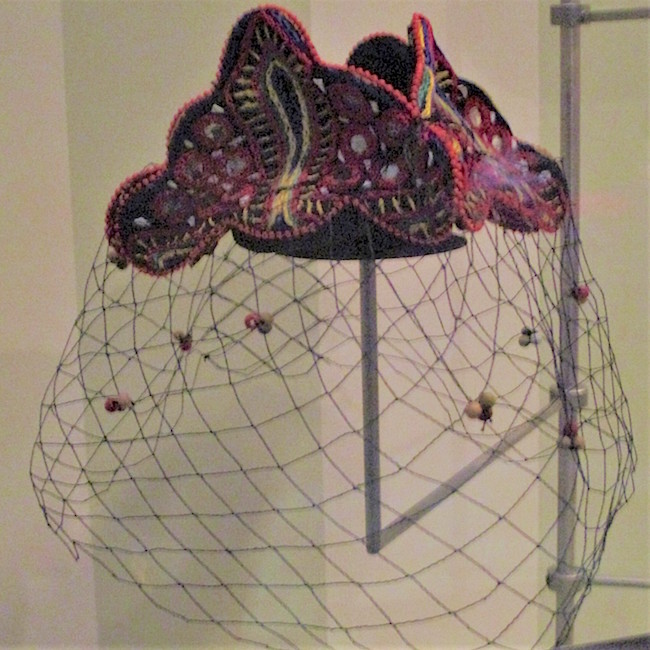
Linen with shisha mirrors, 1958 
Navy straw with butterflies, 1956
Chicago was also the home of the mail order catalog. You have Aaron Montgomery Ward and Richard Sears to thank for our current “buy off the internet”. Then as now, the practice forced smaller stores, many of them rural, out of business because they could not compete.
Near the History Museum, in the Old Town Triangle District, I was seeking Crilly Court, a residential area built in the late 1800’s and redeveloped after WWII. I was particularly interested in this area because many of the buildings were renovated by Edgar Miller.
Edgar Miller was a modern day Renaissance Man, working in sculpting, painting, batik, lithography, architecture, interior design and stained glass. He was an illustrator for Marshal Fields’ magazine and pioneered the use of modern art in advertising during the early 1920’s. He disliked repetition, considering it “the mark of an uncreative artist.” He used recycled materials to turn old homes into works of art, a practice he called “social adventure”, a practice that I found endearing and texturally interesting.

A sidewalk 
A door 
- There are additional photos at Daveno Travels. To read more about this little known artist, I highly recommend “Edgar Miller and the Handmade Home” which is lavishly illustrated.
After dinner, I head back downtown for a drink / photo opportunity at the Palmer House. Rebuilt three times between 1871 and 1926, it boasts 24 floors, 2250 rooms, and a ceiling painted by an unnamed Italian artist.

C.D. Peacock Jeweler was the first business to incorporate in Chicago in 1834, and opened a shop here in 1927. It’s Peacock Doors were designed by Louis Tiffany and cast in bronze, and featured on the Palmer House Christmas card that year. I’m thinking of how to feature this on a hat.


And now, with visions of peacocks a’dance in my head, I’m back to the Pittsfield to retire to bed…
A Berber-inspired Hat…

Travel inspires my work. If you’ve been following me here, you will know that every country I visit, inspires a hat. This one is inspired by a door in a kasbah in Morocco.
The Kasbah Mohayut, on the edge of the Sahara, had doors covered in an ornate configuration of what looked like talismans. My suspicion was confirmed in Marrakech, where I found a copy of a Berber Museum Journal that described the inverted triangular shape as an tizerzaii fibulae. In practical terms, they are worn in pairs, at the chest, usually with a chain connecting the pair together at the lower tip, to secure a woman’s clothing (Viking women wore a similar style of jewelry, for that same purpose). In symbolic terms, they are a protective symbol, something like a Turkish evil eye.
“The mirror-fibuae motif found on the doors in the Atlas operates like a single eye that tattoos each entrance, each important passage into an inhabited place… The eye, and its different representations… may help protect against the black look.” (from “An Aesthetics of Protection” by Salima Naji, Les Cahiers du Musee Berbere, Issue #1, Fondation Jardin Marjorelle Publishers, 2012)
Here’s the hat, and the door that inspired it.

The Making of Raven Steals The Sun…

My trip to Alaska in 2008 was my first solo adventure. I went to see glaciers, totem poles and to get over my fear of flying so I could get to Europe the following year.
While I was there, one of the recurring images I saw on totem poles and jewelry was a bird with a disc in its mouth, a depiction of a First People’s tale called “Raven Steals The Sun.”
The story has several variants, but they all tell of a world of darkness, and of a chieftain who had three cedar treasure boxes containing the Sun, Moon and Stars. The trickster Raven, learning of the treasures and wanting to bring and end to the eternal darkness, shape-shifted into a child who begged to play with the boxes. Once they were in his hands, he turned himself back into a Raven, and taking the treasure boxes, flew up through the smoke hole of the chieftain’s longhouse and high up into the sky. The contents of the boxes spilled out, dividing the darkness into night and day, and bringing light into the human world.
My first full-bird hat – the Raven King – gave me enough confidence to try other dimensional pieces. The Firebird followed, and then the Crow King – my entry in The Met 500 Design Contest, sponsored by the Metropolitan Museum of Art in August 2019.


This new Raven came together pretty quickly, but the Sun proved problematic. Every time I tried to alter a Haida design (shown here) I ended up with a Sun that looked more like flower.


A friend handed me a rubber stamp that leaned towards Gothic, and after several hours of searching the internet for designs to meld with the rubber stamp, my hat took a turn in an entirely unexpected direction.


I liked the ‘tribal gothic’ sun so much that I decided to do all the applique in black leather (which I had stripped off a couch that was destined for the dump). Once I had the Sun in place, Raven decided it would emerge from the cuff, with its wings wrapping around the Sun, catching one of the Sun’s flares in its beak. I stylized the feather detail, to keep the focus on the Raven’s face. The cuff is a herringbone-patterned wool which mimics the chevrons of my embroidery on the wings.


And now I have a hat inspired by my first trip to Alaska, based on a First People’s legend, but with a distinctively Gothic twist. (I would go on to make these in several colors, but the red one remained my favorite.)
A Citadel and a Berber Carpet Shop…

We leave Tinghir and the Todra Gorge, and drive through landscapes of shifting contrasts. We arrive in Skoura and check in to the Ait Ben Moro, an 18th century kasbah that has been restored and converted into a guest house. I find a room that is simple but elegant, and take some time to admire its thick walls, reed and beam ceiling and stone floor.
I head downstairs to visit the carpet shop next door. Aziz, the guest house concierge, accompanies me and once inside the shop, proceeds to show me carpets. I select a small blue one, and Aziz introduces me to his wife, Manar, who is the weaver. But instead of finishing the transaction, she motions to me to join her at her loom.
What are the odds that I would have a second chance to weave on a carpet loom in Morocco?
I take off my shoes and sit down next to her on a cushion. Manar only speaks Berber but that did not pose a barrier to our communication. I would later learn that her name means “lighthouse” which is pretty fitting.
I watch as she throws a weft thread through the upright warp, taps it with her finger, and then handed me the beater – a heavy iron comb with a handle that must weight two pounds – and motions to me to beat the weft down. Manar then shows me how to let the weight of the beater do the work, instead of my wrist. Every time she threw the weft through, she’d turn to me and say “chick chick chick” which is the sound the beater makes against the warp threads. It was also my cue to beat the weft down.


After 3-4 rows of weaving, she demonstrated how she cuts her yarn for the knots by winding it around a crank in the top of her toolbox and then slicing through the yarn by running the tip of a knife down the slot in the crank, and ends up with uniform pieces of yarn which we used to knot her carpet with.


She then shows me how to tie a knot around the pair of warp threads, and then pull it down to the row we had just woven, to start the pile. We only used the beater on the woven rows, never on the knotted rows. Unlike the weaver in Fez, who trimmed her rows as she went, Manar didn’t shear her carpet, so I was careful to make sure the ends of the yarns were even when I placed my knots. She shows me how the heddles work on her loom.


Manar happily pauses while I take a pictoral of this process. Through the language of the loom we communicated pretty well. I continued to add knots to the warp threads, almost as fast as my teacher. Aziz popped in and said I was a quick study and I could come back any time to help his wife in her shop : )

After about an hour of weaving and knotting, I hear Mark’s voice. “It figures we would find you here. If we’re missing Heather, we just start looking for a carpet loom.” He tells me it’s time to visit a nearby historical site. I whine about leaving the loom, but put down my beater and put on my shoes, and signal to Manar that I need to leave. “But I will be back to buy that carpet.”

We through fields of beans and alfalfa dotted with olive and pomegranate trees. A little further on, we come to a wide dry riverbed, Beyond that peeking out from a palm grove, is the most remarkable building I have yet seen – the Kasbah Amridil.

This 17th century citadel is primarily a museum, and one of the most famous buildings in Morocco, even being featured on the old 50 dirham note. We tour in a courtyard filled with artifacts which include an olive press, several clay cook pots and lanterns, and a form used for making the rammed earth walls.
We return to the Ait Ben Moro through the bean and alfalfa fields, and Doug and I go back to the carpet shop. Aziz assists in finalizing my purchase, and then extends an invitation from Manar to join her for tea in their home. She shows me her home and then leads me to a low round table covered with two tablecloths, set with tea and dried fruit, and which is soon covered with bread, jam, honey and butter. Manar and her mother Fatna join us, along with a young woman who is a recent university graduate. We learn that everything we are being served was produced on their land. We also learn that in spite of having a modern kitchen, Fatna continues to bake bread every morning in the wood-fired oven in their back yard. “Tastes better,” she says.
It was such an honor to be invited into this home. The rug Manar wove and which I would carry home on the plane (not trusting it to checked baggage), now has special significance and I will treasure it always.
And now I want to buy a carpet loom…

See the rest of the photos and details at Daveno Travels and Pinterest.