August Phoenix Mercantile
I used to make hats. Now I make other things…
Drama in China: The Costumes…

This is Part IV of a series of articles that is part theater history, part personal retrospect, from a time long ago when I was known in medieval society as Lao Tao-sheng – “Old One, Born to Tell Tales.” My own story started with performances of Waley’s “Monkey” at medieval themed feasts, and culminated in a “One Monkey Show” – a solo presentation of the first seven stories from “The Journey to the West” over the course of seven hours, one August day circa 1983-85 (memory fails as to the exact date). A synopsis of my resume is included in Part I of this series. Text in bold indicate research notes that I applied to my performances. My personal comments are in italics where I need to differentiate them from my research.
You will recall from my previous installment that there was as much emphasis on the character roles as the plot of the play. This theme was carried through into the costuming aspects of Chinese dramas.
There were 300 standard items designed to denote a character’s type, age and social status, through a combination of colors, design, ornament and accessories. Materials included silks, satins and brocades, ornamented with motifs that included clouds, fish scale, rippling water, waves, plants, and and animals; costumes for imperial characters were ornamented with phoenixes (feminine) and dragons (masculine). Color was always symbolic. When a costume wore out, it was replaced with a replica in the same style and ornamentation, but never in the same exact shade.
Opera costumes were made for character roles rather than for specific plays. Although they were based on historic models, costumes could be a fusion of historic styles dating between the 7th – 19th centuries. It was not uncommon for robes to be mixed with footwear, hats and accessories from different periods, and costumes did not need to match the time period the play was set in. (It was this reference to anachronism that gave me leave to combine elements from a variety of costumes that I already had, to clothe the Monkey King for my One Monkey Show. Some of those pieces are collected in the photo that introduces this page.)

Between performances, theater costumes were stored in a chest, in a specific order. It became customary to place a patchwork costume called a fu-kuei i (garment of honor and wealth) on top. The patches were multicolored and symbolized uncertainty but with bright hope of the future, and was worn by those playing the roles of poor scholars or distressed women of virtue. It was placed at the top to bring good fortune to the actors who played those roles.
A small sampling of the more recognizable costumes
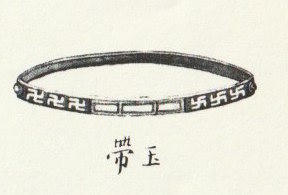
- Mang Robe – a long loose formal robe with a round neck and the skirt slit up the sides (Ming Dynasty). White cuffs were sewn onto the sleeves, and a stiff belt inlaid with with jades and small mirrors, worn around the hips like a hoop (Song Dynasty). (I made a belt for a non-Monkey costume from a wooden embroidery/quilting hoop, which I wrapped in black satin ribbon and glued mirror squares to it from a shattered disco ball. It was more comfortable to wear than I expected.)
- Women actors could also wear a mang robe, knee length and worn over a pleated skirt (Song Dynasty) or a panel skirt (Qing Dynasty). Both male and female roles could also be robed in p’ei or tieh-ts’ – informal flowing robes made from silk or satin and unadorned.
- Shui hsiu – Water sleeves, shown below (which I believe evolved from T’ang Dynasty court dancers.) They were made of silk and extended 2-3 feet beyond your fingertips. (Mine were attached to my under tunic and only extended about 10″ beyond my fingertips, which was all the sleeve I could manage : )

- Fa i – a sleeveless flowing cape worn by Taoist magicians. Another sleeveless cape, called a tou p’eng, was often red, with a low collar, worn to indicate the actor was traveling, or out of doors at night or in bitter weather.
- Chia sha – a red robe decorated with a brick pattern, worn sling across the left shoulder by Buddhist dignitaries.
- Pei’ hsin – a knee-length sleeveless garment that opened down the front, usually worn over pants or a skirt for women’s roles.
- K’ai-k’ao (or Ta-k’u-qo) – a stylized versions of armor worn by the Heroic Warrior, usually made from stiff satin that was heavily embroidered in fishscale pattern (the costume at right was my attempt at replicating a warrior’s costume, made from heavy moire with silk facings. The undershirt was cotton with white sleeves and a silk skirt. The jacket was embroidered in gold fishscale by Merrilee Humason, known in medieval society as Baroness Anastasia.


...A cap of the Three Mountain's Phoenix flying crowned his head,
And a pale yellow robe of goose-down he wore on his frame.
His boots of gold threads matched the hoses of coiling dragons,
Eight emblems like flower clusters adorned his belt of jade...
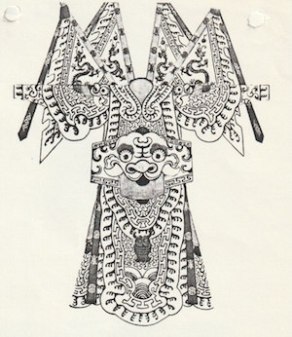
The warrior’s robe evolved in more modern eras to include ‘armor panels’ that hung from the waist to the ground both front and back, and a round collar (like a cangue) at the neck that supported four pennants on the actor’s shoulders (which I believe symbolized the armor he led).
Mandarin patches on formal court robes came into being during the Ming Dynasty and would show up in opera costumes after that period. Horseshoe cuffs date to the Qing Dynasty. There are a number of other items like pants, shirts, vests, turbans and sashes that I do not cover here.
The Colors
Some colors were reserved for specific styles of robes for specific roles. This is a general overview and is not delineated by robe style:
- Yellow was reserved for the roles of Emperor, Empress, Prince, and Dowager Mother.
- Red was worn by court officials and army commanders, as well as the wives, daughters and concubines of the Emperor.
- Crimson was worn by barbarian emperors and sometimes by military advisors.
- Generals wore green, pink, orange, white or turquoise depending on their age.
- Black denoted a nobleman with a cruel nature, whose makeup would match.
- Blue indicated a statesman, sometimes a dishonest one.
- White was the color of mourning in China from the Yuan Dynasty.
I have written an article for a separate series on Symbolism in Chinese Embroidery, which is accessible here via a downloadable pdf.


There were 100 types of headwear worn on the Chinese stage. You could tell how important the character was by how ornate their hat or headdress was.
Warriors wore k’ui helmets, made from beaten metal and augmented with pearls and colored balls of velvet suspended on wires. (I believe this is fairly modern, but may have been highly stylized versions of actual military helmets from the T’ang and Song Dynasties.)
Barbarian Warrior helmets included a pair of very long pheasant feathers, and also a pair of long animal tails (foxes possibly) that hung down their backs. (I have seen modern Chinese dramas where these pheasant feather helmet were worn by women warriors; I suspect the one at left might be an example.)
Warriors might also wear a soft beret (Monkey is often depicted with one).
Officials and Scholars wore a variety of hat styles, nearly always in black until more recent times, sometimes in stiffened gauze, with or without side flaps or back ribbons, embroidered or not, depending on their degree. Emperors wore a version of the hat listed above, usually with side or back flaps, and ornamented depending on the formality of the role.


Empress headdresses became quite elaborate, made from beaten gold, ornamented with phoenixes and covered with kingfisher feathers (Song Dynasty).


Noblewomen, especially courtesans or dancers, would ornament their hair with elaborate ornaments in lieu of a hat or headdress (T’ang Dynasty). Common people could wear broad straw hats, or head scarves or turbans, depending on their character. Men could also wear their hair in a topknot, women’s hairstyles were generally braids (for a young girl) or buns (for an adult woman).

The Footwear
Military commanders wore a high soled boot called a sueh-ts was developed exclusively for the stage. Made of silk, they were highly embroidered to match their robes. Soldiers and servants wore ankle boots with soft soles called k’uai-sie. The soft, short boots were necessary for the acrobatics that actors depicted as battle scenes.
Women wore soft satin slippers with flat soles, which could be ornamented with silk tassels and embroidery depending upon the social standing of the character. Common people and especially laborers could wear straw sandals.

The Dynasties
The dynasties listed in this text point to the earliest time period that these articles would have been worn. Here is your secret decoder ring:
- T’ang Dynasty – 608-907 (7th-10th centuries)
- Song Dynasty – 960-1279 (10th-13th centuries)
- Liao Dynasty – 916-1125 (not referenced in this article but provided here to fill in the gap)
- Yuan Dynasty – 1271-1368 (13th-14th centuries, overlapping with the Song Dynasty)
- Ming Dynasty – 1368-1644 (14th-17th centuries)
- Qing Dynasty – 1644-1911 (the end of dynastic rule in China)
Materials I have referenced in this segment include:
- 5,000 Years of Chinese Costumes by Zhou Xun and Gao Chunming, edited by The Chinese Costumes Research Group of the Shanghai School of Traditional Operas, published by China Books & Periodicals, Inc., San Francisco, California 1987 (the English version).
- The Classical Theatre of China by A.C. Scott, Greenwood Press Publishers, Westport, Connecticut, 1957
- Chinese Theater by Kalvodova Si s-Vanis, Spring Books, London, 1957
- Color photos in this section courtesy of Cheri Dohm, known in medieval society as Sunjan Temujin.
“What I would learn next, will be explained in the next chapter”

Drama in China: Props and Movement…

This is Part III of a series of articles that is part theater history, part personal retrospect, from a time long ago when I was known in medieval society as Lao Tao-sheng – “Old One, Born to Tell Tales.” My own story started with performances of Waley’s “Monkey” at medieval themed feasts, and culminated in a “One Monkey Show” – a solo presentation of the first seven stories from “The Journey to the West” over the course of seven hours, one August day circa 1983-85 (memory fails as to the exact date). A synopsis of my resume is included in Part I of this series. Text in bold indicate research notes that I applied to my performances. My personal comments are in italics where I need to differentiate them from my research.
You may recall from my previous post that Chinese drama evolved from the tales told by street storytellers, into a very stylized art form during the medieval period. Emotional expression was emphasized. Stage movement was related to dance; it was rhythmic and symbolic. Every movement had meaning, and no movement was used that did not further enhance the words spoken by the actor.
Character Roles
Chinese actors trained from the age of 8 or 10, and were taught by masters or older actors, who handed down their roles, choreography and music by tradition. Actors were trained in a certain role type that they would play for the entire career. Once a role was chosen for them, that was the only type of role that actor would study and perform.
Roles fell into four basic categories, each with it’s own signature set of movements and gestures:
- Men – scholar, statesmen, patriot, warrior, tramp, thief, servant. An old man was identified by his long, slow and deliberate steps, his hand on his back, his body bent slightly forward. A warrior would take long, high, stomping steps.
- Women – elder noble, coquette, good wife, war heroine, unmarried girl. Women characters walked with tiny steps, barely placing one foot in front of the other, and on the ball of their foot which would cause them to sway a bit, as though their feet were bound. When a female character runs, they do so in curves rather than in a straight line, with body bent slightly towards upraised hands.
- Painted Face – warrior, bandit, official, and gods, both good and evil. Painted Face roles could be portrayed with swagger and exaggerated strength.
- Comic – servant, soldier, mother-in-law, matchmaker and other common folk. Comic roles were often the most recognizable as common folk.
Gestures and Movement
There were 7 basic hand movements, 20 pointing gestures, and 12 proscribed leg movements. Gestures and movements were dictated by the role of the character as well as the mood and situation.

- Pointing was done with your first two fingers held together and pointing, your thumb bent on your ring finger, and your pinkie finger bent.
- Pointing to a city gate was signified by pointing three times in succession to each of the three characters over a city gate, while repeating the characters outloud, often performed in rhythm to music.
- You could also point with your closed fan.
- Of the hand gestures, one of my favorite ways of showing contemplation was to “tap my temple alternately with two fingers and to walk about anxiously” (shown at right) though I often forgot to curl my other hand behind my back at the same time.
Hand gestures also made use of “rippling water sleeves” – the silk sleeves to your undershirt that extended several inches beyond your fingertips:
- To repulse someone, you literally threw your sleeve towards them with an angry glare before turning your head away.
- Bending forward slightly and holding your water sleeves at face height, quivering them, is a sign of fear.
- Water sleeves can also be used as a curtain – suspended between two actors as one turns to the audience or an accomplice to deliver a side comment.
- Weeping can be indicated by bending your head slightly and holding the tip of a sleeve in the other hand and bringing it near your eye, as though you are dabbing tears with a handkerchief.
- Holding your hands together at lip level, as though in prayer, with your sleeves hanging to the outside, and then physically moving forward three times (with a drum beat) signifies ‘giving thanks’ or extending an invitation.
- Standing with your water sleeves hanging straight down at your sides, indicates that you are a ghost. So unless you have died on stage, never do that!

Pantomime also factored in heavily in the absence of stage sets, and included expressions still used by modern day mimes:
- Extending your hands in front of you to ‘open or close a double door’
- Raising your foot to step ‘over a threshold,’ or raising your foot repeatedly to indicate ‘climbing stairs or a mountain.’
- Suicide was played out by jumping off a table and landing on your back.
- An actor exiting the stage in a long leap might indicate a drowning, or a defeat in battle.
- A long journey was symbolized by circling the stage.
- Entering the stage and then standing on a chair at center stage symbolizes riding on a cloud.
Hand props and banners

- A single banner indicated 1,000 soldiers. A blue cloth painted as a wall could indicate a fort or a mountain pass. A pair of yellow flags painted with wheels served as a chariot or a wagon. A banner painted with fish indicated a river. Streamers carried by an actor who was running, indicated wind.
- Carrying a whip indicated that the actor was mounted on horseback.
- In stage fighting, weapons never touched an opponent’s body. War was carried out as acrobatics with weapons made from bamboo, rattan or wood. A spear could be thrown and caught by the actor who was ‘killed’, and both actors would run off the stage. A corpse could be indicated by a paddle wrapped in a garment.
- Tables and chairs indicated indoor scenes but could also be used to indicate things like a cloud or Monkey’s Iron Bridge. A pair of chairs back to back could indicate a wall, a single chair the door of a prison.
- A curtain hung from a bamboo pole could symbolize a general’s tent or an emperor’s bedroom.
- A fan held beside your face showed that you were standing bareheaded in the sun
- A parasol signaled a monsoon, white paper falling from a parasol indicated snow.
...On two sides were posted scores of celestial sentinels,
Each of whom, standing tall beside the pillars,
Carried bows and clutched banners.
All around were sundry divine beings in golden armor,
Each of them holding halberds and whips,
Or wielding scimitars and swords...

Mimicry and Repetition – my recollections
I was living in Steilacoom, WA at the time, just me and my first husband in a house of many rooms. We converted one of those rooms into a gym, and I covered an entire wall with mirror tile so I could apply my learnings to my rehearsals. I was limited on the amount of staff work I could do for lack of a higher ceiling, but I could work on most other things. Over and over again, 2+ hours a day with more on weekends, practicing hand movements, postures and choreography. All in all, my One Monkey Show took about a year and a half to prepare for.
I remember spending Saturdays watching Chinese costume dramas on the International Channel. They were in Chinese, and rarely had subtitles but the writing was so formulaic you could get the jist of the plot after having seen a dozen or so films. Warrior monks spun sideways through the air and off of impossibly high buildings as they fought their opponents. Generals stomped around with serious facial expressions, growling voices and fierce gestures. Concubines peeked coyly from behind their water sleeves, speaking in lilting high pitched voices and laughing in tones that sounded like falling water. Young scholars walked with determination and a whiff of naivety. Heroes did what heroes do, and fools were downright vaudevillian. Each role had specific vocal intonations, physical movements, gaits, and gestures that defined their characters.

I tuned in to a couple of martial arts competitions, where several of the entrants (both male and female) performed “Monkey-style” kung fu, both with and without staff work. My library would expand over the next several months with booklets that would detail the basic movements of houquan (Monkey-style), zuijiuquan (Drunkard’s Boxing) and hung chia (Double-end staff) which I would practice mid-week with a friend whose name was Draggi, and by myself on weekends, whenever I could find an open field while camping with the medieval society.
“The Dragon King took Wu-k’ung to the sea treasury, where there was a huge pillar, some twenty feet long…Near one end was an inscription which read: “Golden Clasped Wishing Staff: weight 13,500 pounds…” All the inhabitants of the palace watched Monkey display his magic staff, making thrusts and passes as he walked along…
One lucky weekend, the Chinese Peking Opera Company of Chongqing made Seattle their third stop on their first North American tour, and gave four performances at our Opera House which included “Sun Wu Kong, the Monkey King, probably the most appealing Peking Opera character for Westerners…” The story they presented was the “Banquet in the Peach Garden” which was one of my favorite tales. The reporter for the Seattle Times wrote: “The Monkey King sounds like W.C. Fields, Charlie Chaplin and Shakespeare’s Prospero all wrapped up in one character.” It as a traditional performance, leaning heavily on costume, makeup, stylized movement and acrobatics, against a curtained backdrop and augmented with a few banners and hand props. I would never gain the acrobatic skill and fine-tuned gestures and expressions that this Monkey showcased, but it was pretty wonderful to see a live performance..

Altogether, these resources provided a veritable live-action library that I could learn from through mimicry and repetition.
Materials I referred to in this chapter include:
- The Journey to the West: Volume I, translated by Anthony C. Yu, University of Chicago Press, 1977
- The Classical Theatre of China by A.C. Scott, Greenwood Press Publishers, Westport, Connecticut, 1957
- Chinese Theater by Kalvodova Si s-Vanis, Spring Books, London, 1957
- “The Art of Spectacle” – a review of the Chinese Peking Opera Company at the Seattle Opera House, by Wayne Johnson, Times drama critic, The Seattle Times (date unknown).
- Various Chinese costume dramas and martial arts competitions aired on International TV (dates unknown)
“What I would learn next along this way, will be explained in the next chapter…”


Drama in China: “The Journey”…

This is Part II of a series of articles that is part theater history, part personal retrospect, from a time long ago when I was known in medieval society as Lao Tao-sheng – “Old One, Born to Tell Tales.” My own story started with performances of Waley’s “Monkey” at medieval themed feasts, and culminated in a “One Monkey Show” – a solo presentation of the first seven stories from “The Journey to the West” over the course of seven hours, one August day circa 1983-85 (memory fails as to the exact date). A synopsis of my resume is included in Part I of this series. Text in bold indicate research notes that I applied to my performances. My additional comments are in italics where I need to differentiate them from my research.
A Big Gift of a Small Book

You will recall that my introduction to the “Tales of Monkey” took the form of a 5″x7″ book, containing 305 fragile pages of Arthur Waley’s translation of a much larger work attributed to a 16th century poet by name of Wu Ch’eng-en. The Waley book has no copyright or publishing information and my only clue to it’s age is the introduction written by Dr. Hu Shih, dated December 15, 1942.
It began with the following passage:
“There was a rock that since the creation of the world had been worked upon by the pure essences of Heaven and the find savours of Earth, the vigour of sunshine and the grace of moonlight, till at last it became magically pregnant and one day split open, giving birth to a stone egg…”
Excerpts from this first chapter of Waley’s book formed the framework of my first Monkey Tale performance.
A few months later, another gift arrived. It was “The Journey to the West” by Wu Ch’eng-en, translated by Anthony C. Yu. It was the first full translation of the original work, which took Dr. Yu six years to complete, and which filled four volumes and nearly 2,000 pages.
The poetry in the Yu translation, that Waley had eliminated from his, was absolutely enchanting:
...Soaring peaks arise from the Sea of the East.
There are crimson ridges and portentous rocks.
Precipitous cliffs and prodigious peaks.
Atop the crimson ridges, Phoenixes sing in pairs;
Before the precipitous cliffs, the unicorn singly rests...
Green pines and cypresses keep eternal their spring...
Within a single gorge the creeping vines are dense;
The grass color of meadows all around is fresh.
This is indeed the pillar of Heaven, where a hundred rivers meet...
The stories were filled with such lyrical text and descriptive poetry, that it would inspire me to start committing them to memory, performing them as single stories at medieval events, and then, eventually, seven stories, back to back, during that day-long One Monkey Show.

About “The Journey to the West“
“The Journey to the West” is considered one of the four most famous classic folk novels in Chinese literature. It is a 100 story allegory based on the travels of a monk who traveled west from China to India in search of Buddhist scripture. It is a mix of high fiction and religious doctrine, which some scholars believe was written with the intent of teaching morality and virtue. Although the monk, who would later become known as Tripitaka, was born into a Confucian family and became a Buddhist, many of the allegorical references in Wu Ch’eng-en’s work are based on Taoist philosophies which sometimes wander down mystical paths. Those who are familiar with the Eastern philosophies of Buddhism, Confucianism and Taoism will not be surprised by this intermingling of doctrines.
As I stated in Part I of this series, authors of Chinese literature often built upon the stories handed down through generations. Keeping the traditions of the Song Dynasty storytellers, authors further embellished these stories with their own prose and poetry, based in lyric styles of rhyming quatrains of 5-7 syllable lines (which is why I also ended up studying Chinese lyricism during my preparation of these stories). “The Journey to the West” combines prose and a great deal of beautiful poetry. Poetry was used as the more descriptive vehicle, while prose tyed the poetry together and supported the narrative.
To get into why a set of fictional animal characters came to be the protectors of a Buddhist monk, and why those characters have become more popular than the real-life person the tales are based on, would take us deeper into the rough than I want to go in this synopsis. For those readers who are interested, I refer you to the 62 page Introduction in the first volume of Yu’s translation.
Putting literary analysis aside, I enjoy the flow of Wu Ch’eng-en’s narrative style and the incredible beauty of his poetry, as well as the touches of magic and alchemy that thread through his tales. I hope that’s what held my audiences to these stories as well.
A column of rising white rainbows,
A thousand fathoms of dancing waves---
Which the sea wind buffets but cannot sever,
On which the river moon shines and reposes.
Its cold breath divides the green ranges;
Its tributaries moisten the blue-green hillsides.
This torrential body, its name a cascade,
Appears truly like a hanging curtain.
About Wu Ch’eng-en
Although there have been several versions of “The Journey to the West” written by multiple authors over a number of centuries, the most famous version (and the version I work from) is attributed by most literary experts to Wu Ch’eng-en.
Wu Ch’eng-en was a novelist and poet, educated as a Confucian. He was born in Jiangsu Province in about 1504, and died there in 1582. He spent some of his life in the lower echelons of civil service, never including as a resident scholar at the University of Nanjing. In addition to “The Journey to the West” he wrote several poems and other works in prose, some of which were critical of society’s corruption. He became dissatisfied with the political climate and lived his later years as a hermit artisan.
About Tripitaka, on whom the work is based
The “Journey to the West” is loosely based on the pilgrimage of Hsuan-tsang, a 7th century monk who disobeyed Emperor T’ai-tsung, and left China in the dead of night to travel West to India in search of Buddhist scripture. He returned to the Chinese city of Chang’an after a trek that took 16 years and covered 10,000 miles.

Hsuan-tsang was 27 years old when he started out from Chang’an, hiding by day and traveling by night on horseback. He crossed the Taklamakan Desert and passed through the Jade Gate that marked the furthest edge of T’ang Dynasty China, and onto the Northern Silk Road, along the base of the T’ien Shan Mountains. He would pass through Samarkand and other cities with his small caravan before crossing the T’en Shan mountains into India. Like Marco Polo would do centuries later, Hsuan-tsang recorded his impressions down to the most minute detail. He spent two years in Kashmir studying Buddhist doctrine under the tutelage of a sage, before spending a dozen or so years circumnavigating the entire Indian continent. He studied Sanskrit at Nalanda Monastery, a famous enclave for Buddhist monks. He met with kings, khans and leaders of his faith, and at times served as an emissary. He became one of the greatest metaphysicians in medieval Buddhist history.
He left India after 14 years, returning to China in 645 CE. He arrived with several statues of Buddha in a variety of sizes and materials, and a library of 657 books. He recorded his travels in the “Record of the Western Region” which took him a year to write. He would leave behind a legacy that included contributions to Indian history, archaeology, Chinese literature, and his translations of Buddhist scripture. His travels would become glorified and handed down as folktale and legend, culminating in one of China’s most famous works, and the evolution of The Monkey King as a national folk hero. His own name would be replaced with “Tripitaka” – which translates into “the three baskets of Buddhist wisdom.”
Gold Cicada was his former divine name.
As heedless he was of the Buddha's talk.
He had to suffer in this world of dust,
To fall in the net by being born a man...
...Declining office, he wished to be a monk,
To seek at Hung-fu Temple the Way of Truth,
A former child of Buddha, nicknamed River Float.
His religious name was Ch'en Hsuan-tsang.
About my own journey with “The Journey”
As the stories in the Yu translation are quite lengthy, I edited them to shorter versions, retaining as much of the poetry as I could, with just enough narrative to tie the poetry together and keep the plot intact, while removing the repetitive phrasing that Wu Ch’eng-en utilized. I also kept audience attention span in mind. I had learned early on that it is better to keep an audience wanting more, than to bore them with a single story that runs too long.
I worked to commit the scripts to memory, 2-3 hours a day, one page at a time, by sheer repetition. I would repeat it over and over on my daily commutes, moving on to the next page only after I could recite the previous page, literally in my sleep. Sleep itself became a secret weapon…I recorded script onto a pocket dictaphone, which had a place on my pillow and which would continue to play even after I had fallen asleep. It’s amazing how much you can memorize when you let your sub-conscious do the heavy lifting…
…While Monkey King was fighting his way out of the city, he was suddenly caught on a clump of grass, and stumbled. Waking up with a start, he realized that it was all a dream…
The Journey to the West,, Chapter Three
Committing each story to memory took 4-6 weeks. Those who attended the One Monkey Show may recall that I read some passages. Wherever the story had a character reading from a book, register, summons or invitation list, I worked that into my performance. So out of those 7 hours, I estimate that I committed just under 6 hours of script to memory.
Materials I referenced in this chapter include:
- The Journey to the West: Volume I, translated by Anthony C. Yu, University of Chicago Press, 1977
- Xuanzang: A Buddhist Pilgrim on the Silk Road, by Sally Hovey Wriggins, Westview Press, 1996
- China Travel Depot and Wikipedia.com (for the biographical information about Wu Ch’eng-en).
“What I would learn next along the way, will be explained in the next chapter…”

Drama in China: An Applied History…

In the early 1980’s, Master Payne introduced me to a medieval society known as the SCA. About a year in, and leaning on my strengths in Shakespearean soliloquy from my high school days, I decided to develop a persona as a 13th century storyteller. I began telling Tibetan creation stories at feasts and bardic competitions before my brother Payne gifted me with a copy of “The Adventures of Monkey“ by Arthur Waley. It whetted my appetite and I started to search for the source material for Waley’s translation, which segued into a deep dive into the study of Chinese street theater and associated art forms that would coalesce in the 16th century into what is know known as “Beijing Opera.”
This is Part I of a series of articles that is part theater history, part personal retrospect, from a time long ago when I would become known in medieval society as Lao Tao-sheng – “Old One, Born to Tell Tales.” My own story started with performances of Waley’s “Monkey” at medieval themed feasts, and culminated in a “One Monkey Show” – a solo presentation of the first seven stories from “The Journey to the West” over the course of seven hours, at a medieval event called Ducal War, at a park in Oregon, on a weekend in August circa 1983-85 (memory fails as to the exact date…). I would continue to present singular stories for “A Winter’s Court” for KCTS TV in Seattle in 1985, and at the World’s Fair in Vancouver BC in 1986, and at a living history demonstration at the “Nomads of Eurasia” exhibit in Los Angeles in 1989. I shelved my actor’s arts in the mid 1990s in favor of other, less arduous pursuits.
Text in bold indicate research notes that I applied to my performances. My personal comments are in (italics) where I need to differentiate them from my research.
An Exceedingly Brief History of Drama in Medieval China, and how it inspired me to tell the Tales of The Monkey King.
Theater in China evolved, as it did in many cultures, from the masked song-dances of religious festivals. The earliest documented examples in China date to about the 3rd century BCE. Dance was always combined with spoken verse and song, and were considered to be inseparable.
During the T’ang Dynasty (7th-10th century) short stories called marvel tales evolved. Often written as one-act dialogs. the marvel tales added to the development of narrative techniques, and later served as the material on which the plots of full dramas were based. The earliest form of what we now identify as drama, is attributed to Emperor Hsuan Hsung, known as Ming Huang (712-54 AD). He founded the “Academy of the Pear Orchard,” in his pear garden in Ch’ang-an, where actors and singers were trained to perform at Court. Ming Huang is regarded as the patron saint of theater in China; it is said that even now, before going on stage, actors burn incense in front of his image that hangs in greenrooms in playhouses across China.
By the Song Dynasty (10th-13th century) the components of full drama were well established. Stories had dramatic plots and included singing with instrumental accompaniment. Dialog, dance, costume and makeup became essential elements of storytelling.
My specific field of study was the Yuan Dynasty (13-14th century) when the Mongols ruled China under the reign of Kublai Khan, and later Tamerlane. By this time, opera was was starting to replace dance as the popular form of performing art. Medieval Chinese Opera was evolving into a composite of drama, music, dance, martial arts and acrobatics which told stories of love, court intrigue, histories and fables.
It was during this time that the “tsa chu drama,” or miscellany play, evolved. These plays were based on well known tales and legends told by the balladeers and storytellers of the streets and marketplaces. Working with the audience’s familiarity of a story, the playwright would elaborate on the plot for dramatic effect. Audiences in turn, would be both highly receptive and demanding (not unlike the audiences who would attend the plays of William Shakespeare and Ben Johnson two centuries later).
Many of the Yuan tsa chu plays were written in and around the Mongolian capital of Khanbalik (modern day Beijing). Scholars theorize that when the Mongols invaded China and Kublai Khan replaced Chinese government officials with his own people, the displaced scholars – now forced into retirement – channeled their time and education into developing the two literary forms that would become the hallmarks of artistic achievement in China during the Yuan Dynasty – the novel and the drama.
The novel developed from the oral traditions (which I assume includes the marvel tales) of the storytellers. Each chapter began with “honored reader, you will recall how…” and ended with “honored reader, if you want to know what happens next, please listen to the explanation in the next installment” (a variant of this is how I ended nearly every Monkey story I told to my audiences.)
The Yuan tsa chu dramas formed the basis of what would become the modern day Beijing Opera. Plots for these dramas were drawn from historical sources both real and legendary. Ancient Chinese history was written with fact and myth combined (a thing held in common with the Arthurian legends of the British Isles). Classic themes were always historical in nature, tended towards the fundamental conflicts in life, and were used as an educational tool to teach both history and virtue (similar to the morality plays of ancient Greece). Plays were not categorized as comedies / tragedies, but fell under two categories: 1) civil themes of love, court family life, with spoken verse interlaced by songs that were accompanied by stringed instruments, and 2) plays devoted to themes of war, with acrobatic dance battles and duels, accompanied by percussion instruments.
Two distinctive styles of drama evolved. Northern dramas were often tragedies, with simple music played predominantly on lute. Southern plays were written in a series of shorter acts which resulted in productions that could be several times longer than their Northern counterparts. Duets and choruses were introduced in the Southern version, and plays had happy endings, with the actors accompanied with soft and melodic music played on flute. These plays presented as a series of fairy tales, and made storytellers prevalent.
Southern style Tsa chu dramas would often take 6-7 hours to perform. Rather than presenting one work in its entirety, a selection of scenes from several plays would be performed. Costumes were based on palace dance costume and court clothing. Makeup included substances such as chalk powder, ink and soot. Stage sets were minimal; action took place on a stage which was dressed with a painted backdrop, and an occasional table or chair. Hand props included fans, banners, fly-whisks and stylized weapons.
Medieval Chinese drama evolved around the skill of the actor, and audiences would often go to a playhouse to see a particular actor rather than a specific story. The most important actors were those who played heroes, generals or imperial officials. Women’s roles were not considered important prior to the 20th century.
Playhouses in China began as simple raised stages, surrounded on three sides by the audience. Beginning in temple courtyards, the theater later fell under the the patronage of the Royal Court (I assume sometime after Emperor Ming Huang’s ‘Pear Orchard Academy’ during the T’ang Dynasty). Traveling troupes (not unlike Europe’s troubadours) would travel from town to town and perform at festivals in the towns, on stages of wood and bamboo that could be disassembled quickly. Permanent theater structures seem to have evolved closer to the 16th century and were born from teahouses, where patrons would eat, drink, and chat with friends while watching the drama of the day. In fact, they weren’t called theaters, but rather ‘tea gardens.’
The theater was attended by both the educated class and the general populace. The starkness of the empty stage served to contrast the makeup, costume and acting style of the performer. Every gesture, facial expression, vocalization and gait, and by extension, costumes and makeup were symbolic. Medieval Chinese drama evolved from the tales of the early street storytellers, into a formal and stylized art form by the 16th century, which is where my brief history ends.
One of the aspects of my One Monkey Show that I tried to impress on attendees, was that they were not expected to stay for the entire production. I encouraged them to bring food and drink, and converse with friends, and come and go as they pleased. I was frankly pretty surprised when just over half of the audience stayed put for the entire performance.
My sources for this installment include:
- “The Classical Theatre of China” by A.C. Scott, Greenwood Press Publishers, Westport, Connecticut, 1957, which I recommend highly to any student of medieval Chinese drama.
- “The History of Chinese Dance” by Wang Kefen, Foreign Languages Press, Beijing,1985.
- Personal notes from sources I did not note and which I can no longer remember…
“Honored readers – if you want to know how this story progresses, please patiently wait for the next installment…”

It hangs with pride and fond memory on my living room wall.
Phoenix Rising
Once upon a time, there was a hatmaker who lived in a house, filled with hats, a cat, birds and fish, and surrounded by a garden.
Every so often, the hatmaker would host a “Phoenix Rising” soiree on the date of the August Moon, to thank all those who had supported her work that year. She would fill the place with hats and food and games. And after her guests had eaten all the food and played all the games, they were invited into the garden for a moon viewing, because that’s what you did in August at the hatmaker’s house : )
This year, Phoenix Rising returns in a virtual realm on the August Moon (8/22/2021) with a viewing of a different sort…

post show at peters valley

Thank you for attending the Peters Valley Spring Virtual Craft Market last weekend!
As you can see, my booth was open after hours so the ShopCats could check in…
If you arrived at my booth during one of my breaks, or wanted to learn more, here is the five-part series, downloadable in pdf format:
- Stitchery Part I: History and Fibers
- Stitchery Part II: Tools and Techniques
- Stitchery Part III: The Stitches
- Stitchery Part IV: Chinese Symbolism
- Stitchery Part V: Applique
And because I received comments and requests, here is The Making of Crow King!

If you missed the show, you can shop all of the artists from the Exhibitor’s Page at Peters Valley!
I’m accepting custom orders, so if you’re looking for something new, give me a shout!

Venetians and Florentines…

My first taste of the world outside of the US was in 2009, when I attended Carnival in Venice. I kept a journal of those travels, which you will find at Daveno Travels. Here’s a teaser of what you will find there:


My trip to Venice launched both my hunger for travel, and my catalog of “Travel Inspired” works. These hats were the result of my travels to Italy between 2009-2011, and are shown alongside the architectural elements that inspired them.
Of this collection, my Venetian became one of my most popular styles, inspired by the iron bridges that cross the canals in Venice. I would also develop a Venetian Garden with applique foliage on a padded cuff.


My Carnival was a one of, inspired by a Venetian window I saw at sunrise and to commemorate my first trip here, which was during Carnival.


The next most popular was my four panel Medici, which was inspired by the vaulted ceilings over an exterior courtyard at one of the Medici Palaces in Florence. The construction of this hat is actually Central Asian, making it a bit of a cultural fusion piece.


My Florentine Cap was inspired by a door knocker that I saw, somewhere in Florence.


The two hats were not architecturally inspired, but echo the richness of Italian Renaissance fashion and textiles.


Design inspiration is all around you. You just have to open your eyes to the possibilities…
Crossroads Tour: Roberto Capucci in Florence…
Most of my travel journals are now at Daveno Travels. This is a segment from my second trip to Florence in 2011 and an unexpected encounter with the works of this haute fashion designer.
I am wandering around in Florence on Mother’s Day, 2011. It’s the last day of my second trip there, so I’m trying to see all the things I missed the first time around. One of those things was the Villa Bardini, a 17th century mansion and gardens, a short distance from Palazzo Pitti and the Forte di Belvedere.
I found a number of paintings in hallways, leading to galleries with lights on motion sensors. It was an interesting experience because I didn’t know what I was walking into until I entered a gallery and triggered the lights. So imagine my utter surprise, when after viewing several paintings that barely held my attention, I walked into a dark gallery, and triggered the lights, and exposed this…
It’s a Roberto Capucci exhibit. I know nothing of this designer, but his work is super impressive in both design and detail. It was a real treat being able to walk completely around the mannequins and absorb all of the detail. The first room I walked into, contained this single dress, titled “Giorgini”:


Capucci created this ‘fabric sculpture’ in honor of his mentor, Giovanni Battista Giorgini, who is considered the father of Italian fashion. Born in 1898, Giorgini started in the early 1920’s to promote “Made in Italy” by opening a buying office in Florence and catering to American department store customers, products of Italian high crafts in silver, leather, Florentine straws, Murano glass and Faenza ceramics. After surviving the Depression and WWII, in 1945 he organized the Allied Gift Shops across Italy, and brought an exhibition titled “Italy at Work” to Chicago in 1947.
In January 1951, Giorgini gathered together all of the most important Italian designers of the time, and a 20 year old beginner – Roberto Capucci. This collective produced the first Italian High Fashion Show the following month (and I believe) launched Capucci’s career in fashion design.
The “Red Bride” was my favorite from this exhibit. Capucci crafted this garment in 2009 from a fabric called ‘mikado.’ The bodice is embroidered with red and gold crystal beads, and the dress itself is made by a series of trapezium shaped elements in two alternating shades of red which form the side wings and train. Capucci was influenced by a number of historical and cultural elements for this gown. Brides wore red in Europe until the second part of the 17th century, as well as brides in India, China and Byzantium. The gold veil was intended not to obscure the bride, but to “exalt the preciousness of the person…” and to indicate that the bride was the mistress of herself and of her future.
I took advantage of the hall of mirrors to grab a couple of rare selfies with these beautiful works.


The next gallery included sketches of several of the gowns. I’m always interested in seeing how an artist’s sketch translates into a finished garment. I was also quite taken with the detailing on this leather skirt overlaid on a silk shift.


This suit is pin-tucked and pieced silk. The detailing was immaculate.


The next room had about a dozen gowns that were very architectural.

The next room after that, Capucci returned to softer and more feminine forms.


If you visit the Villa Bardini, be sure to ask a docent to unlock the door to the balcony on the third floor, which affords you the absolute best panoramic view of the city. You will also want to allow yourself about an hour to enjoy the gardens. The rest of the details of my final day in Florence are at Daveno Travels.
The Final Fifty
Now that the COVID-19 vaccines are on their way into arms, I am shipping out what I believe will be the last fifty face masks, these destined for the Navajo Nation. I have made around 800 masks over this past COVID-19 year, most of which I have donated, some of which I have sold and then donated the profits. It has been an honor to do my very small part in serving my communities.

As I shift from mask-making to the making of other things, some of which have been waiting for over a year to start, it’s a good time to share one of my favorite Turkish proverbs:
“Don’t look back – you’re not going that way”
One of those long overdue other things was this pair of custom hats, commissioned by one of my collectors. He supplied the upholstery vinyl which worked out better than I expected it to. The seams are built up with yarn braids held down with cross stitching, to give the impression that these hats have more heft than they actually do. The tassels are one-of-a-kind’s as well, created from stuff I had laying around. I do love when projects come along that I can finish off with the odd trinket(s), made from pieces of things, some of them have been in my shop for over a decade.
I think Charlie will be thrilled to own a pair of hats like no other…


Looking forward rather than back, I’ve got a couple of shows coming up.
I have a “Not For Sale” piece in the RAGS Virtual show this year. After you have gawked at the gallery, head on over to the MarketPlace to buy wearable art made by other local artists. If you’re familiar with my signature socks, they come from one of the vendors here – Polonova socks and gloves feature historical and ethnic art motifs and have been a favorite of mine for several years. The RAGS Wearable Art Sale & Show is an annual fundraiser for the YWCA Pierce County. Historically held at Larson’s Mercedes-Benz of Tacoma in Fife, the event has moved online this year and runs March 14-21.
The fall show at Peters Valley was so much fun that we’re doing it again! The Spring Virtual Craft Market at Peters Valley will run May 1-2. It’s a really great way to meet artists from all over the country and buy their handmade wares. If you tuned in for the last show, you saw me with some new styles, some works in progress, and a 360 degree studio where I make your hats. Consider this an encore, with details coming soon. If you can’t wait ’till May, you can shop a selection of my ready-made hats online through the Peters Valley Gallery.
I won’t be traveling this year, so I’m using that time to consolidate and expand my past global adventures as “Director’s Cuts” at Daveno Travels. I’ve finished my first trip to Italy and am starting the next trip (the start of the Crossroads Tour). If I go in chronological order, next up will be Istanbul. But I may surprise you with Spain instead, just to keep you on your toes.
Stay safe, stay protected, get your vaccine as soon as you can, and we’ll see each other soon.
the DuSable Museum in Chicago

I visited Chicago in 2018 on a self guided tour of its architecture, museums and historical sites. One of those museums was the DuSable Museum of African American History, established in 1961 to promote the contributions and experiences of African Americans. It is housed in an unassuming building, filled with well laid out galleries that take you through some of the most turbulent time periods in our shared history.
“Rewriting History – Paper Gowns and Photography” was an art installation that filled the first gallery I entered. It provided a ride through antiquity and imagination, and is among the most emotionally impactful art installations I have walked through. When art intersects with social consciousness, it can take you to powerful places.
Fabiola Jean-Louis is mixed media artist who was born in Haiti, and raised in New York and Brooklyn. She created life-sized paper gowns and staged photography to tell African-American history in the trappings of 15th-18th century Europe. Her goal was to use beauty as a vehicle to discuss ugly truths regarding the African Diasporic experience and open a dialog into social change.
The “Tudor Dress” stood near the center of the room. Again, this is made entirely from paper.


All the mounted pieces in this exhibit were presented in heavy baroque frames. The models are wearing paper gowns created by the artist, which are then photographed. The final technique is archival pigment print on hot press paper. I cropped the frame out of some of my photos in order to enlarge the detail.

The first frame below is titled “Madame Leroy,” who is wearing an ornate triptych.

The next frame is a detail shot titled “Rest In Peace” and shows the devil in the detail – a black man who has been lynched from a tree bursting into bloom.


Some of these works drew me back again and again. This pair struck me for the subtlety of the basket of ginned cotton in the lower right corner, and the details of the violin. The first frame is titled “Passing,” the next is titled “Violin of the Dead.”


“Marie Antoinette is Dead” was another image that was not as it first appeared. Note the African doll under her arm, and the voodoo dolls in the corner of the second frame.


There were some stand alone pieces, like this Elizabethan inspired dress (lower left), and a stomacher (lower right) entitled “Garden and Tea”, a multi-media piece which includes gold leaf, crystals and shimmer trim. There was another stomacher and two pair of papermache shoes in this exhibit that I did not photograph.


Of all the pieces in this exhibit, this one had the greatest visceral impact on me. Sometimes art needs to be painful in order to make its point.


Titled “Madame Beauvoir’s Painting,” the detail shot shows the pattern on the back of her dress and its correlation to the lash marks on the back of the slave she is painting.
This last work is titled “They’ll Say We Enjoyed It” which says all it needs to.

This blog was originally posted as “Yesterday’s Main Street and the Dusable Museum” in August 2019. It was updated in February 2021 for Black History Month, to focus on this singular exhibit and includes photos not previously seen here.