Glass and Textiles from Rabat…
Most of my travel journals are now at Daveno Travels where I am reissuing them as Director’s Cuts, with full text and previously unpublished photos. This is an excerpt from my trip to Rabat, Morocco in 2017, where I had my first Moroccan meal,
Rabat is the capital and the political, administrative and financial center of Morocco, and the second largest metropolis behind Casablanca. The city dates to the 10th century and was located near the Roman port of Sala. I am told it has a bit of pirate history although I have not yet tracked that down.
We drive along the crenelated wall of the Kasbah of the Oudaias which surrounds the oldest part of the medina, and find a place to park. The rest of our way is on foot through the covered alleys to our lodging for the night.

We walk through an unassuming wooden door and into a courtyard, 3 stories tall, covered at the top with a pyramid-shaped glass ceiling. We have arrived at our first riad – the the Dar El Kabira. I admire a tall set of carved double doors with large brass barrel locks, and nearly fall over backwards when they turn out to be the doors to my room …


Our guide, Doug Baum, takes us down to the waterfront for a spectacular sunset, and steals this shot of me in my new traditional Moroccan caftan and pants. I would buy clothing in nearly every city we visit, after arriving without any luggage. (My suitcase was waiting for me in Casablanca at the end of this three week trip.)

Dinner tonight is at the Dar Naji restaurant, where we sample our first classic Moroccan cuisine, and a very skilled waiter who is pouring tea into six glasses which he is rotating in one hand, and pouring from above his head in the other.

The next day, after breakfast, I run up and down the stairs, trying to find the embroidered caftans that I can see hanging on the walls from the courtyard floor. The maids sound French, and are dressed in white shirts, pants and short aprons, with crisp white bonnets covering their hair. They’re looking at me from around the corners and giggling, and the manager of the hotel finally tells me that they are pleased to see a guest in traditional dress. “Tell them I lost all my clothes at the airport, and I am now dressing Moroccan.” One of the maids leads me to –the other staircase– which gets me to the third floor and allows me to complete my quest. I have included photos of the infamous staircase, and a piece of Chinese brocade upholstery from a chair in the lobby, which was a fun thing to see here.


Today we visit the Mausoleum of Mohammed V, a leader revered as the father of Moroccan Independence. The mausoleum was commissioned by his son, Hassan II and was built by 400 Moroccan craftsmen using white Italian marble. Its stained glass windows and dome hail from France.

We finish the day roaming around in the Kasbah of the Oudaias, the 12th century fortification at the head of the medina, restored during the 17th-18th centuries. We did not get into the museum or the gardens, but I hear they are highly recommended. Make plans to see them when you go.

See additional photos of the sites of the day at Daveno Travels.
Pro-bono projects – and Morocco…

This news story was originally posted in early March 2017 on my previous website. I am reposting it here for posterity and public record : )
The absence of blog posts is an indication of just how busy I have been over the last few months.

First of all, I want to announce that I am pausing hat production for the rest of March. I am joining a small band of intrepid travelers on a three week tour of Morocco. Our guide, Doug Baum, is renowned both for his camel tours of Egypt, India, Jordan and Morocco, as well as camel treks in the SW US. He is as the owner / operator of the US Army Camel Experiment, established to educate the public on the historic use of camels in America in the 19th century. Brace yourselves for an onslaught of blog notes and photos upon my return …
In January I delivered a dozen handmade caps to a Vendor Appreciation event for Real Change News. I challenged myself in November and December to make these caps as part of my annual philanthropic efforts. Real Change is an advocacy group working towards ending homelessness and poverty in the Pacific NW. This project was so much fun that I hope to make it a new annual giving tradition.


Late last year I was approached by The Underground Railway Theater, a theater group in Cambridge, who were looking for hats for a play titled “Homebody Kabul”. They provided me with some off-the shelf imports and asked me to rework them so they would look handmade and echo the descriptions from their script. It was an interesting process, turning imported hats into stage props… My Homebody Kabul album on Facebook shows the original hat in the comments section for each makeover, and included quotes from the play in selected photos. I donated three of the hats to keep them within their allotted budget.

“…Several months ago I was feeling low and decided to throw a party and a party needs festive hats. So I took the tube to where there are shops full of merchandise from exotic locales, wonderful things made by people believe as I do not…whose grandparents believed in magic, believed that some combination of piety, joy, ecstasy, industry, brought to bear on the proper raw materials…”
from “Homebody Kabul” – a play by Tony Kushner.
My next project was the Women’s Marches in Seattle, Sacramento, Olympia and Washington DC. After trying to knit a hat, I turned to my “linen closet” and produced hats with a hand stamped design and ears in two variants. I randomly selected 10 men and women, and gifted them with a custom made hat for them to wear, as well as one to give away that was patterned after the knit version. The results of that project are captured in The Art of the March.
These hats became so popular that I added them to my Custom Catalog, in a variety of colors and cuff treatments, with 50% of the purchase price benefitting Planned Parenthood. I have sold about 20 so far. If you would like to order one, they will be available again after April 5.
The black and pink hat shown here is the one I wore in the Seattle March, and has been accepted as part of the permanent collection at the Fashion History Museum in Cambridge, Ontario, just as soon as I can get it shipped.

I am now working on a hat for the Science Marches that will be occurring on April 22. I am still working on the prototype, which will be made of linen in your choice of color, with an atom embroidered on the top, and a DNA strand handstamped to the sides. The cost will be about $65, and I plan to donate about 20% of the purchase price to an organization working to support women in the sciences. The leading candidate is the Scientista Foundation, although I am also collecting other suggestions. If you are interested in ordering this hat, I am not collecting money right now, but do give me your name, head size and color preference. Ears are optional and at no additional charge.
I am now off to finish hat orders and attend to a list of logistics for my upcoming trip. See you when I get back!
Stitchery Part V: Applique…

This is the last in this series, which has focused on (mostly) Chinese embroidery as a surface embellishment. This segment will cover a few other forms of surface decoration that can be combined with embroidery to bring new color, texture and uniqueness to your own textile projects.
Reverse appliqué is my favorite technique and can add a lot of dimension to your project, especially if you are working in several layers of heavy fabrics. I used this technique for a small round pillow with five layers of wool. By the time I was done, the pillow gave the impression of being carved rather than sewn.
Grab some history and technique of this process at the download below:
Stitchery Part IV: Chinese Symbolism…

Every symbol in Chinese textiles had significance, and evolved from several philosophies and concepts. The Chinese enjoy puns and plays on words, and often designs were used if their verbal sound or written character was similar to a quality or virtue. Hence, because the words for bat and happiness sound similar, bat became the symbol for happiness.
The invention of the draw loom and the development of jacquards and brocades allowed patterns to be woven into the cloth. Common patterns included checks, diamonds, zig-zags, coins, clouds, dragons, lions, horses, flowers, birds and fish. Brocades were often over-embroidered to augment the woven patterns (a technique I now employ on my hats…)
Learn more about Chinese Symbolism in embroidery and textiles here:
Stitchery Part III: The Stitches…

This installment provides a ‘Cliff Notes” historical overview of embroidery stitches in China and Europe, and rolls right into the stitches themselves.
There are somewhere around 100 – 150 identifiable embroidery stitches used worldwide. I have only captured here those that are the oldest and most recognizable. For additional stitches, please look into the additional resources at the bottom of this post.
Across Andalucia: The Golden Threads…
Most of my travel journals are now at Daveno Travels where I am reissuing them as Director’s Cuts, with full text and previously unpublished photos. This is an excerpt from my trip to Cordoba in 2012, highlighting my textile finds in the Jewish Quarter.

I leave the Mezquita and admire the palms, as they filter shade onto the hard-packed clay that paves the public spaces here. I am off to the Jewish Quarter, one of the best preserved and largest urban Jewrys in Europe. There are two homes of note here, across the street from each other, as well as the Synagogue.
The first home is Casa de Sefarad. The first room of this house is filled with absolutely stunning metalworked textiles as well as jewelry and household objects.
Sephardic Jews introduced the production of Golden Thread from North Africa to Europe via Morocco, Turkey and the Mediterranean. Gold and silver were smelted in specialized furnaces to produce this thread, which was then spun with silk to make it pliable. Golden Thread production contributed to the social structure of single and widowed Jewish women, who were the chief creators of both the thread and the textiles it embellished. Sephardic Jews had a leading role in the production of this thread up to the 20th century.
The jacket below was worked in what looked like both gold and silver. It was interesting to note the difference between the men’s shoes (with the upturned toes) and the women’s shoes (that were flat).


I admire cases of jewelry, including a pair of silver cloak brooches, and a metal wedding cap similar to those I saw in Bursa.


I am stunned to find a full size painting of Lubna, a 10th century Cordoban woman with extensive knowledge of calculus, metrics, and math. She worked in the library of Caliph Al-Hakim II, considered the most important depository of knowledge at the time. She is also a doppelgänger for a friend of mine, Kate O’Guinn.

Across the street is Andalucia House, whose claim to fame is a scale model of one of the first paper making factories in the Western world. Paper was invented to China, and carried by Muslims during the 10th century to Europe via Bagdad, Sicily and Spain. I have boarded the papermaking process on Pinterest.
Click here to see more of the Casa de Sefarad. Learn more about the Jewish Quarter at this website.
Crossroads Tour: Chapel of the Magi in Florence…
Most of my travel journals are now at Daveno Travels. This is an excerpt from my second international trip in 2011, where I returned to Florence. I have included it here to share the costume detail and the story behind the painting.
I visit one of the Medici palaces and literally stumble into one of my favorite Renaissance works. It visually stunning for the minute detail Gozzoli went to in depicting the clothing, jewelry and horse trappings of the time. I never thought I would see it outside of an art book. And yet, here I stood, just inches from it. Nothing could have prepared me for the visceral impact of seeing it in person.
“The Journey” portrays a processional celebrating the Christian Epiphany, with the Magi and their retinue represented as the members of the Medici family and other political and cultural nobles of the time. In addition to the portraiture, the fresco bears other references to the Medici family, including the colors and elements of their heraldic device (red and blue, red bezants and groupings of three white feathers.) The villas in the background suggest the Medici country estates. There are also scenes of various hunting parties, with symbology attached to some of the animals, and which makes a very lush and exotic landscape.
It is thought that this work commemorates three separate events – the Council of Basel in 1439 which was called to unite the Latin and Greek Churches and to deal with the Turkish threat (which would ultimately lead to the fall of Constantinople in 1453); the celebration of the Epiphany in 1459 that Cosimo Medici was patron and benefactor to, and in which a very young Lorenzo Medici played one of the roles during the reenactment festivities; and the celebration held in Florence later that year to honor Pope Pius II.


See more of the Chapel of the Magi at Daveno Travels.
Crossroads Tour: Last day in Istanbul…
Most of my travel journals are now at Daveno Travels where I am reissuing them as Director’s Cuts, with full text and previously unpublished photos. This is an excerpt from my first trip to Istanbul in 2011.
I’m joined at breakfast by another guest from Australia who is also leaving today. Baha offers to take us to the bazaar to buy suzani (the embroidered textiles that fill his hotel). I don’t think I can cram anything more into my suitcases but the offer is more than the Australian and I can resist.
We arrive at Baha’s favorite textile vendor and are offered tea and seats. We make our selections and are each gifted with a pillow cover. I smile when I notice that the embroidery on mine is incomplete. Baha notices, and pantomimes “needle and thread,” suggesting that I could finish the embroidery myself.

I am also gifted with a black silk ikat headscarf (shown below with a wool shawl I bought at the Topkapi Palace. Sadly, I lost both of these pieces at an event in North Seattle in 2019.)

I photograph a framed goldworked section of an Ottoman robe that is leaning against a wall behind a pile of other things in one of the booths in the Bazaar.


After that shopping expedition, I locate the Ibrahim Pasa Palace, a building that dates back to the Ottoman period which houses the Islamic Art and Ethnology Museum. It’s a treasure trove that would make some of my friends want to move here. One of the centerpieces is a nomads tent, called a kara cadir in Turkish, woven from black goat hair with center pole supports, much like a Bedouin tent.
There were Anatolian kilims here that were woven in one piece, a rare find as they are traditionally woven in two or three sections and then stitched together. Below at left is the style of carpet I was looking at in the shop on my first day in Istanbul (this one from the Caucasus, Central Anatolia-Konya, 18th – early 19th century). I am told that the more borders the carpet has, the higher the value. The $48,000 carpet I was shown on my first day here had 5 borders in addition to it being 90 years old and dyed with cochineal, indigo and saffron. (At center – a Lotto style carpet, 13-14th century, Sultan Alaadin Keybubat Mosque in Konya, with a detail shot of that carpet shown at right.)


A loom with all of the weaver’s tools laid out…

Some clothing and home furnishings, including a reproduction of the interior of an 1800’s Ottoman home. This pair of chopines for hamimi (Turkish bath) also date from the late Ottoman era. Mother of pearl inlay on wood, straps appear to be appliqued and beaded textile. Sorry I didn’t take a closer look to see if it that strap was a felt or woven piece…


After a very full and final day, I return to the hotel. My shuttle is due at 3:30 AM, and since I am the last guest, Baha and I sit and talk in the dining room. We talk about my Facebook albums, and the route my plane would take on its return to Seattle, and if there are sharks in Puget Sound. Cars, and sports, and music. Whatever small talk our tired brains could manage.
The shuttle arrives. Baha loads my book-heavy luggage into the van. He gives me a warm European-style send-off and promise to keep in touch. It has been a remarkable trip, and I will never, ever forget this place…


Read the full account at Daveno Travels.
Across Andalucia: Toledo…
Most of my travel journals are now at Daveno Travels where I am reissuing them as Director’s Cuts, with full text and previously unpublished photos. This is an excerpt from my trip to Toledo in 2012, highlighting my textile finds and hat inspirations.
My travels have taken me from Venice to Florence, and Genoa and to Istanbul – all centers of commerce during the medieval period, and of heightened artistic and scientific endeavors during the Age of Enlightenment. My next destination continues to trace a path through Europe as it existed under Muslim occupation – to Andalucia, in search of the remnants of medieval Spain when it was under Moorish rule.
Toledo is a small but historically important fortified town, halfway between Madrid and Cordoba. This Iberian city served as a Roman trade hub, a Visigoth capitol during the 6th century, and a Moorish capitol in the 8th century before the Christian Reconquista in 1085. It was the capitol of Spain until 1561 when Philip I moved Spain’s political center to Madrid. It remained Spain’s religious capitol.
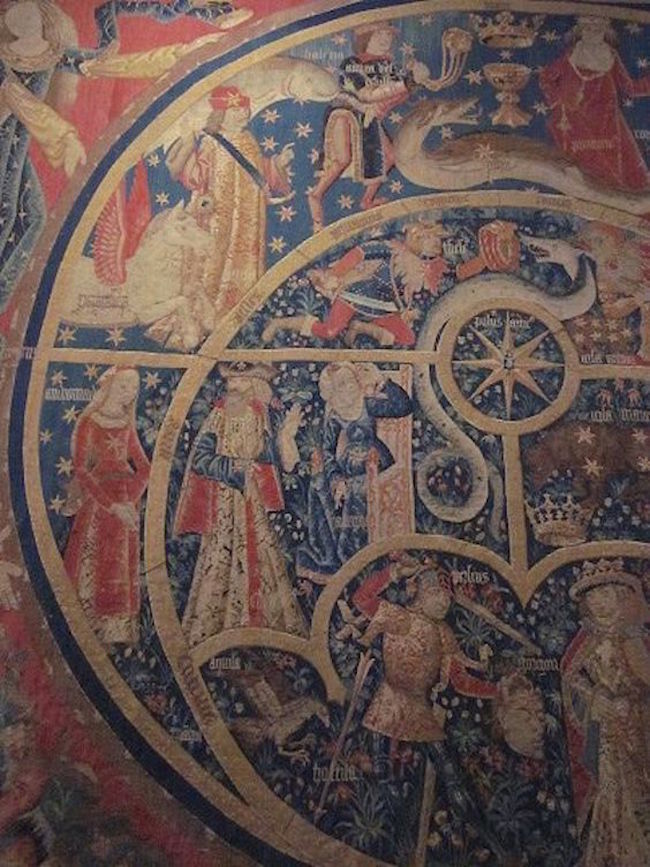
One of the highlights of this trip was the Museo de Santa Cruz, as noteworthy for its architecture as its contents, was formerly an orphanage and a hospital. It is home to the famous Tapestry of the Astrolabes. Woven in Belgium in 1480, it combines mythology and science to explain the divine world as it was perceived during the Middle Ages. It covers a wall, floor to ceiling and is about 12′ across – much larger than I thought it was. I spent about 20 minutes here, just trying to absorb all the details.


The Cathedral of Santa Isabel was built in 1227 over the foundation of a 6th century Visigoth church, which itself had been built over a mosque. It houses floor to ceiling works carved from the most beautiful marble I had yet seen. Of equal workmanship were the wooden pews, which appear to be of mahogany, and depict the defeat of Granada. The castles depicted in these carvings are stylized, but the clothing, armor and weaponry are so accurate that historians study the panels to learn the evolution of weaponry of the period. They are also said to be the largest carved choir in all of Europe.


The Chapel of St. Blaise, with its lapis-blue ceilings and murals, was stunning. The halos of the saints, done in gold leaf, were in remarkable condition for frescoes dating back to 1397. One of the treasure rooms is filled with vestments, and I see an alter cloth that had been woven by Muslims, who had included an Arabic border around the central lozenges.


The Cloister of St. John the Kings was begun in 1389 by Rodrigo Alonzo under the direction of Archbishop Don Pedro Tenorio. It was finished in 1425. Finely wrought archways surround a courtyard which is intensely lush and beautiful. This cloister would be among the finest example of Spanish-Arabesque Gothic architecture I would see on this trip. It would take me about 6 years to translate this design into one of my hats.

The rest of this journal, including photos and details about the Neo-Moorish Toledo train station and architectural detail from the mosques and cathedrals in Toledo, are now available at Daveno Travels.
Stitchery Part II: Tools and Techniques…

Through personal experience, I have found that needles of bone and ivory, although retaining a sharp point longer than other materials, are also coarser and more brittle, which causes them to break easily. Bronze needles are the best for embroidery as they have a smooth surface and are more pliable than modern steel needles. A pliable needle helps to decrease sore and fatigued fingertips.
I am fond of Chinese scissors which made from iron and hold their edge well, and which are available in a variety of sizes from the bonsai section of your garden store, or your black powder / sutlers fairs if you are a reenactor. I also keep my grandfather’s pliers close at hand because it is sometimes easier to pull -rather than push- a needle through dense fabric or leather. A Chinese pin cushion and a jade pin dish round out my kit.
Learn the rest of my favorite techniques by downloading the article: